

Blogs | Khaira Education
Hi, How Can We Help You?

Blog

May 23, 2026

OET scores can do much more than simply tick an English – language requirement box; they can open doors to new countries, better roles, and long – term career growth for nurses. While I do not have live access to external verification tools right now, the points below reflect how OET is widely used in international nursing pathways.

Q1. How do OET scores unlock international registration?

For many English – speaking countries, a qualifying OET score is one of the standard requirements for overseas nurse registration. Nursing councils and regulatory bodies use OET because it focuses on clinical communication-reading charts, writing referral – style letters, and speaking with patients and families. Meeting the required bands shows regulators that you can operate safely in an English – speaking healthcare environment.

Once you have the accepted OET scores, other parts of the registration process, such as document verification and professional exams, can move forward. Without those scores, your application may not even be considered. In this sense, OET is a gateway: it changes your status from “interested applicant” to “eligible candidate” in the eyes of overseas regulators.

Q2. How can OET scores improve your job opportunities and salary?

Strong OET scores signal to employers that you are ready to communicate confidently with patients, families, and multidisciplinary teams from day one. Hospitals and recruitment agencies know that nurses with good OET results are less likely to struggle with handovers, documentation, or patient education. This makes you a more attractive candidate in competitive international markets.

Better communication also tends to be linked to better performance reviews, smoother probation periods, and quicker integration into teams. Over time, this can influence the kinds of wards or specialties you can join, your chances of moving into supervisory roles, and your overall earning potential. In short, OET scores don’t just get you into the system; they can help you progress within it.

Q3. How do OET scores help you specialise and advance?

As your career develops abroad, you may want to move into specialised areas such as ICU, oncology, theatre, community nursing, or advanced practice roles. These paths usually demand clear communication in complex situations: discussing risks, explaining procedures, coordinating with doctors and allied health professionals, and documenting detailed care plans. The preparation you do for OET-especially in Writing and Speaking-builds exactly these skills.

Learning how to write concise, focused letters teaches you to summarise cases for specialists. Practising role – plays makes it easier to handle sensitive conversations about diagnosis, prognosis, or lifestyle change. In many settings, this level of communication is a key factor in selecting nurses for specialist posts or leadership tracks.

Q4. How can OET preparation boost everyday clinical confidence?

Even before you move countries, preparing for OET can transform how you feel and perform at work. As you practise explaining conditions in simple English, checking understanding, and responding empathetically, you become more confident handling English – speaking patients in your current hospital. This confidence reduces stress, especially in high – pressure areas like emergency and critical care.

Stronger language skills also help you participate more actively in ward rounds, handovers, and multidisciplinary meetings. You may find it easier to ask questions, clarify orders, and advocate for your patients. This professional presence is noticed by colleagues and managers and can change how you are perceived, even before your international move happens.

Q5. How do OET scores support long – term mobility and security?

Once you have a valid OET result that meets or exceeds common regulatory requirements, you gain more flexibility in planning your future. If circumstances change and you decide to move to a different English – speaking country, your OET score may still be accepted there, subject to each regulator’s rules and validity periods.

This gives you options rather than tying your entire plan to a single destination. In the long term, having demonstrated English proficiency through a healthcare – specific exam can also support applications for promotions, internal transfers, or further education such as postgraduate nursing programmes. It provides formal evidence that your communication skills meet an international standard, which is reassuring for universities and employers alike.

Q6. How can you use OET scores strategically in your career planning?

To get the most from OET, treat your target scores as part of a bigger career roadmap rather than just an exam goal. Before you book the test, research the requirements for the countries and nursing councils you’re interested in, and set your score targets accordingly. Aim not just to “scrape through,” but to reach a level that gives you confidence and some margin above the minimum. After you achieve your scores, include them clearly on your CV and in job applications, highlighting any strong sub – test results that show particular strengths in communication.

Continue using the skills you developed-structured writing, patient – friendly explanations, active listening-in your daily practice. In this way, your OET result becomes both a key that opens international doors and a foundation you build on throughout your nursing career.

Ultimately, OET scores can transform your international nursing journey by turning ambition into eligibility, eligibility into opportunities, and opportunities into long – term growth and mobility. When you see the exam as an investment in your professional identity-not just a hurdle to pass-it becomes a powerful tool for shaping the future of your career.

May 23, 2026

Balancing family, finances, and OET preparation is one of the hardest parts of the migration journey for nurses, but with a realistic plan and clear priorities, it becomes manageable instead of overwhelming. Think of it as designing a “whole-life” study strategy, not just an exam timetable.

Q1. Why is OET so challenging for migrant nurses with families?

For many migrant nurses, OET is not just an exam; it is tied to visas, job offers, children’s education, and long-term financial security. That makes the emotional pressure very high. At the same time, you may be working long shifts, sending money home, and managing responsibilities as a parent, partner, or caregiver.

Time, energy, and money are all limited, and OET preparation competes with urgent daily needs. This combination means you cannot afford a “perfect student” routine. You need something flexible and forgiving that accepts real-life interruptions. Recognising that your situation is genuinely demanding is important, because it stops you from comparing yourself unfairly to candidates who study full-time or have fewer responsibilities.

Q2. How can you plan OET around family responsibilities?

The first step is to make your family part of your OET plan instead of treating them as an obstacle to it. Talk openly with your partner, children (if they are old enough), or other relatives about why you are preparing for OET and how it will benefit everyone in the long run. When your family understands that your study time is an investment in their future, they are more likely to support and protect that time.

Next, look at your weekly routine and identify small, regular blocks where you can study with minimal interruption. For many nurses, this might be early mornings before others wake up, or one quiet hour in the evening. Aim for focused 30-60 minute sessions rather than long marathons. Plan lighter tasks on days when family duties are heavy, such as vocabulary review or listening practice, and save more demanding tasks-like full Writing or Reading sets-for quieter days or when someone can help with childcare.

Q3. How can you manage OET costs without harming your finances?

OET is expensive, especially when you include exam fees, materials, and possible coaching. The key is to treat it like any other major financial commitment: plan, budget, and avoid unnecessary repeats. Start by listing expected costs: exam fee, a realistic amount for preparation (books, online resources, or a course), and any travel expenses for the test centre.

Then decide what you can afford each month without putting essential bills or family needs at risk. You might choose to delay your exam date slightly so you can save gradually, rather than rushing into a sitting you are not ready for. Use high-quality free or low-cost resources where possible, and spend money strategically on things that give the biggest return-such as targeted feedback on Writing and Speaking if these are your weak areas. This careful approach reduces the chance of paying for multiple unsuccessful attempts.

Q4. How do you cope with guilt about time away from family?

Many migrant nurses feel guilty when they study because they think they are taking time away from children or partners. It helps to reframe this mentally. Instead of seeing study time as “stealing” from your family, see it as “building” for your family. You are working towards better income, stability, and opportunities for them.

Sharing this perspective with your loved ones can ease the emotional pressure. You can also create small rituals that keep connection strong even when you are busy. For example, you might dedicate a short, device-free time every day to talk or play with your children, or keep one evening a week for family activities. When your family sees that you still care about them and that OET is a temporary, purposeful project, the guilt reduces and their support increases.

Q5. How can you protect your physical and mental health?

Balancing work, family, and OET is physically and emotionally demanding. Without basic self-care, you risk burnout, which hurts both exam performance and family life. Try to maintain regular sleep as much as your shifts allow, even if it means studying slightly less. A tired mind learns slowly and forgets quickly, so four focused hours a week are often better than ten exhausted ones.

Include simple stress-management habits in your routine. Even a few minutes of deep breathing, stretching, or a short walk can help reset your mind. Watch for warning signs like constant irritability, frequent illness, or feeling hopeless about OET. If these appear, it may be better to reduce your study load briefly or push your exam date back, instead of pushing yourself to breaking point.

Q6. What kind of study routine works when you are working and supporting a family?

A practical routine for many migrant nurses is a “little and often” model. For example, you might do 30 minutes of Listening or Reading on workdays and 60-90 minutes of Writing or Speaking practice on days off. Use travel time or small gaps during the day for lighter tasks, like revising phrases, reading health articles, or listening to short audios.

Link your study plan to your work and home life. If you had a clinically heavy day, choose lighter OET work that evening. If your shift was easier or you had a day off, you can attempt a full mock test or more intensive practice. Keep your weekly goals clear but modest-such as “two Writing tasks, two Speaking sessions, and three short Listening/Reading practices”-so you feel progress without constant pressure.

Q7. How can you involve your support network?

You do not have to do this alone. If possible, ask your partner, relatives, or close friends to help with specific tasks that free up study time, such as watching the children for an hour, helping with household chores on mock-test days, or giving you a quiet space. Even small acts of support can make a big difference.

You can also look for study partners who understand your situation-other migrant nurses balancing similar responsibilities. Studying together online or in person once a week can keep you motivated and accountable. Sharing challenges and small victories with people who “get it” reduces the feeling of isolation and helps you stay on track.

Q8. How do you decide when you are ready to book the exam?

When money and family hopes are involved, you need to be strategic about your exam date. Instead of booking based on emotion (“I’m tired of waiting; I’ll just try”), use evidence from your practice. You might decide you are ready when you consistently reach your target scores in mock tests, especially in Writing and Speaking, which are harder to judge. Be honest with yourself: if your practice scores are still far below your goal, booking immediately may add more financial and emotional stress.

On the other hand, do not wait for absolute perfection. There will always be some nerves and some mistakes. Aim for a realistic balance: a strong, consistent practice level that shows you are likely to pass, combined with a clear plan for the remaining weak areas. Balancing family, finances, and OET is a long, demanding journey, but it is also a powerful investment in your future as a migrant nurse. By planning carefully, protecting your health, involving your support network, and taking steady, realistic steps, you can move towards your international goals without sacrificing the people and stability that matter most to you.

May 23, 2026

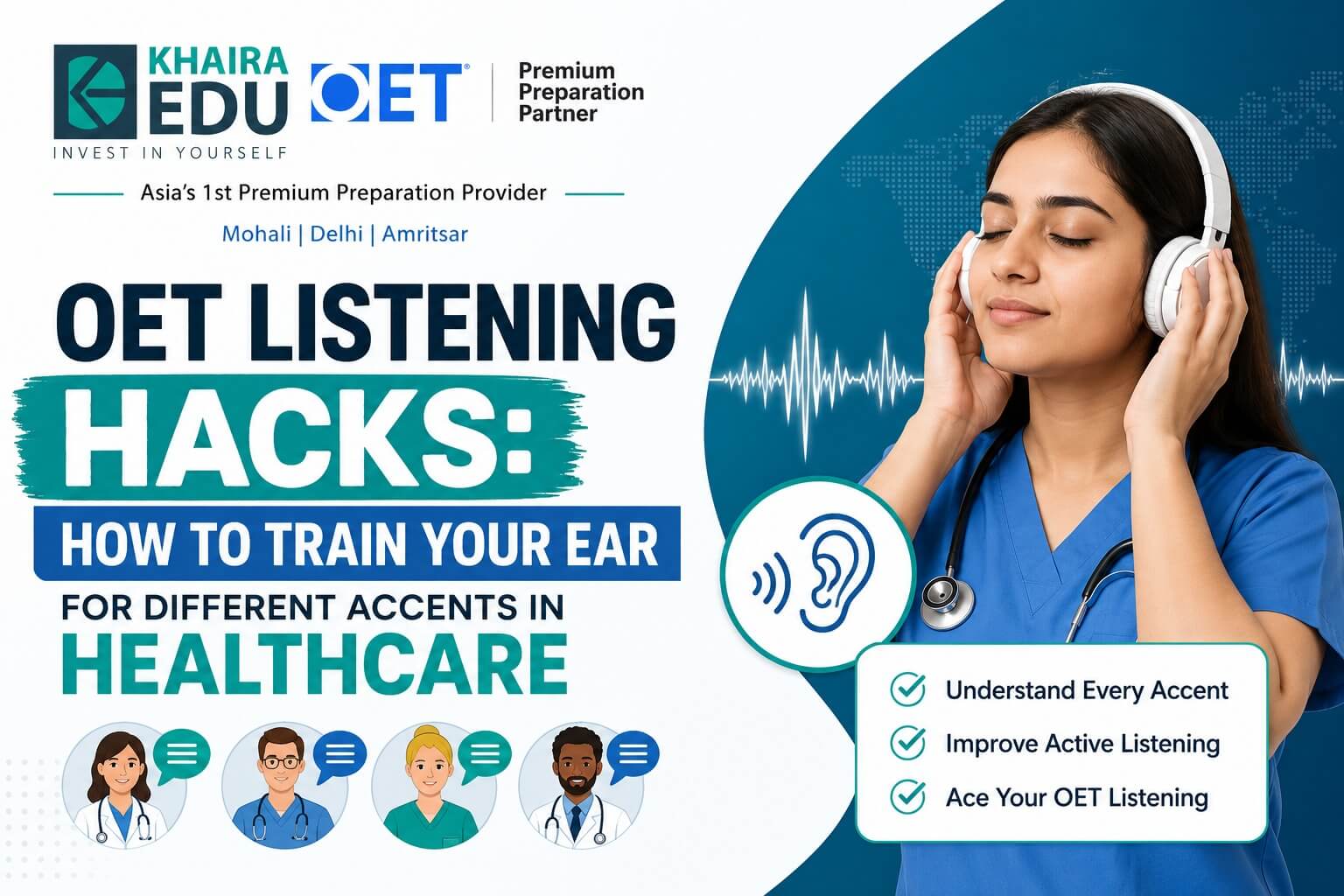
OET Listening becomes much easier when you deliberately train your ear to handle different accents, speeds, and speaking styles commonly heard in healthcare settings. Even without external tools right now, the strategies below follow the standard OET Listening format and widely accepted listening skills techniques.

Q1. Why do accents cause problems in OET Listening?

Many candidates can understand English well in the classroom or on TV but struggle when they hear unfamiliar accents, especially under exam pressure. In OET, you may hear a range of native and nonnative accents British, Australian, American, and others because the test reflects real international workplaces. If you only Practise with one type of English, your ear is not ready for this variety.

Accents affect sounds, rhythm, and even how words are linked together, so familiar vocabulary may suddenly seem “new.” When you are anxious, your brain also needs more time to adjust, which can make you miss whole phrases. Training your ear in advance reduces this shock and helps you focus on meaning instead of getting stuck on pronunciation.

Q2. How can you build a solid base for OET Listening?

Before focusing on accents, you need a basic habit of active listening to healthcare content. This means listening with a clear purpose, not just having audio in the background. When you listen, always ask yourself, “What is the main problem? What tests or treatments are mentioned? What advice is given?” This keeps your brain engaged and closer to the way OET questions work.

It also helps to get used to typical consultation structure: greeting, history, examination or tests, diagnosis, and plan. The more familiar you are with this pattern, the easier it becomes to predict what kind of information might come next, even if the accent is new. Prediction is one of the most powerful listening skills because it fills in small gaps when you miss a word or two.

Q3. How do you start training your ear for different accents?

The best way to get comfortable with accents is gradual, repeated exposure. Choose short healthcare related audios or videos in different English accents and listen to them regularly. At first, do not worry if you do not catch everything. Your goal is to let your ear “meet” the accent several times until it stops sounding strange.

Begin with shorter clips so you are not overwhelmed. Listen once to get the general idea, then listen again and focus on key words such as symptoms, time expressions, numbers, and treatment names. Over time, you can move to longer consultations and discussions. The more your ear recognizes the rhythm and sound patterns of an accent, the less energy you need to understand it in the exam.

Q4. What specific techniques help you cope with unfamiliar pronunciation?

When you meet a new accent, you may notice that some sounds are dropped, joined, or changed. Instead of panicking, focus on context and word shape. Ask yourself: is this likely to be a symptom, a test, a date, or a number? Even if you miss one word, the surrounding information usually tells you what kind of word it must be.

Shadowing is a useful technique here. Play a short sentence, pause, and immediately repeat it aloud, copying the speaker’s rhythm and intonation as closely as you can. You do not need to become an expert mimic; the goal is to train your mouth and ear together. This makes fast or connected speech easier to recognize later, and it also improves your own speaking naturalness.

Q5. How can you use healthcare content to train your ear daily?

Since you are preparing for OET, it makes sense to train your listening with medical or healthcare content, not random audio. Listen to patient stories, health education talks, or interviews with doctors and nurses. These often contain the same types of vocabulary and structures you will hear in OET Listening: explaining symptoms, discussing diagnoses, and giving lifestyle advice.

Try turning this into a routine. For example, listen to a short health related clip once or twice a day, perhaps on your commute or during a break. The first time, just follow the general message. The second time, focus on details such as what tests are ordered, what advice is given, or what follow-up is planned. You can even pause and summaries what you heard in one or two sentences, which strengthens both listening and speaking skills.

Q6. How should you Practise with OET-style questions?

To connect accent training directly to exam skills, you need regular practice with OET-style questions under time pressure. When you work with sample tasks, always read the questions first, underlining key words. This prepares your brain to listen for specific information instead of trying to understand every sound equally.

During the audio, concentrate on the part of the conversation linked to each question. If you miss one answer, do not let frustration distract you from the rest. Make a quick guess and move on mentally. After the practice, listen again without answering, just to understand the conversation more fully. Notice where you lost information: was it a fast pronunciation, an unfamiliar accent, or simply a moment of distraction? This reflection helps you target what to improve next time.

Q7. How do you train for numbers, names, and critical details?

Accents can make numbers, drug names, and dates harder to catch, but these details are often tested in OET. To train this skill, focus on short clips or recordings that include many numerical details. Listen specifically for times, dates, dosages, and measurements. Practise writing them down quickly and clearly, just as you will in the exam.

You can also pause after a key sentence and repeat the numbers aloud, which reinforces recognition. If a particular type of number (for example, “thirteen” versus “thirty”) confuses you, look for more listening practice where that contrast appears. Over time, your brain learns to expect certain patterns in healthcare contexts, such as common medication doses or appointment timings, which makes recognition easier even with accent variation.

Q8. How can you stay calm when the accent feels difficult during the exam?

Even with good preparation, you may meet an accent on test day that feels harder than expected. The most important thing is not to panic. Remind yourself that you do not need to understand every single word to answer the questions correctly. Focus on the task in front of you, use the written questions as a guide, and keep listening for key information rather than trying to translate every sound.

If your mind starts to race, use your breathing to steady yourself between parts of the test. A slow, deep breath can reset your focus. Tell yourself, “I don’t have to catch everything; I just need the important points.” This mindset keeps you flexible and allows your training to work, even when the accent is challenging.

Q9. How can you combine all these hacks into a simple routine?

A practical listening routine for OET could look like this: several times a week, do a short, timed OET-style listening task; then on other days, listen to one or two brief healthcare audios in different accents. After each practice, review where you had trouble, and spend a few minutes shadowing difficult sentences or repeating important phrases. Try to mix focused exam practice with more relaxed exposure to diverse accents so your ear stays active without becoming overloaded.

Over weeks and months, these small, regular steps train your ear to recognize meaning across different voices and styles. When you finally sit for OET, you will not be hearing those accents for the first time; they will already feel familiar, allowing you to concentrate on the questions and show the listening skills you have worked hard to build.


May 23, 2026

Top OET preparation mistakes often come from good intentions but poor strategy, especially when you’re juggling shifts, family, and high expectations. Understanding these traps and how to avoid them can save you time, money, and stress.

Why do so many healthcare professionals struggle with OET prep?

Many nurses and doctors assume that because they use English at work, they don’t need a targeted plan for OET. In reality, the exam tests specific skills like structured letter writing, timed reading, and profession‑focused role‑plays that even experienced professionals haven’t practiced for years. Without a clear strategy, they repeat the same routine, take the exam, and end up disappointed with their scores.

Another big reason is time pressure. Busy professionals often try to “fit OET in” around everything else instead of designing a realistic schedule. This leads to cramming, irregular practice, and a constant feeling of being behind. The result is not just lower performance, but also higher anxiety on test day, because you know deep down that your preparation wasn’t organized.

Mistake 1: Treating OET like a general English exam

One of the most common mistakes is preparing for OET in the same way you would prepare for a general English exam like IELTS or TOEFL. Candidates focus on essays, generic listening clips, and academic reading, but OET tasks are built around healthcare scenarios, patient communication, and professional letters. This mismatch means a lot of study time doesn’t translate into exam readiness.

To avoid this, make sure most of your practice materials are OET‑style or healthcare‑specific. Work with case notes, clinical texts, and role‑plays that mirror real consultations. When you read or listen to something, ask, “How similar is this to OET?” If the answer is “not very,” keep it as extra practice but don’t let it dominate your study plan.

Mistake 2: Ignoring Writing structure and task requirements

Many healthcare professionals underestimate OET Writing, assuming that “I write notes all the time, so I’ll be fine.” In the exam, however, you must produce a clear, well‑organized letter that selects only relevant information and addresses the reader’s needs. Common mistakes include copying too much from the case notes, mixing important and unimportant details, and using informal or unclear language.

To fix this, learn and practise a standard letter structure that you can adapt in the exam. Always start with a clear purpose, group related information into logical paragraphs, and think from the reader’s perspective: “What do they need to know to continue care?” Regularly write letters from sample case notes and review them critically for organization, tone, and relevance not just grammar.

Mistake 3: Practising Speaking only “in your head”

Another frequent mistake is preparing for OET Speaking silently, by imagining what you would say instead of actually saying it. In the real exam, you must speak under time pressure, manage a patient’s emotions, and keep the conversation organized. If you haven’t practiced out loud, your language may come out less clear and confident than you expect.

To avoid this, build regular out‑loud practice into your routine. Use simple consultation structures greet, explore the problem, explain, check understanding, and close and speak through them with a partner or into your phone’s recorder. Listen back to check whether your explanations are patient‑friendly and whether you sound rushed or flat. Speaking practice must feel slightly uncomfortable; that’s how you know you are preparing realistically.

Mistake 4: Avoiding timed practice for Listening and Reading

Many candidates do Listening and Reading practice without a timer, then get shocked when they run out of time in the real exam. Working slowly at home can hide serious problems with speed, decision‑making, and concentration. You might feel “good” in practice yet lose marks when the clock is ticking.

The solution is to build timed practice into your schedule from early on. Regularly complete full parts of Listening and Reading under exam limits, then review your answers afterwards. Notice where you lose time: rereading the same paragraph, over‑thinking options, or panicking when you miss a detail. Adjust by learning to skim, scan, and move on when needed. Learning to manage time is as important as learning language.

Mistake 5: Studying “everything” instead of targeting weaknesses

A lot of healthcare professionals respond to a low score by trying to “study harder” across all skills, without analyzing what went wrong. This usually leads to frustration because time and energy are spread too thin. You might already be strong in Listening but weak in Writing, yet you divide your efforts equally, so the weak area never gets the attention it needs.

To avoid this, start with a clear assessment of your current level either from past scores or honest practice tests. Identify your weakest sub‑tests and the specific problems inside them, such as letter structure in Writing or inference questions in Reading. Then spend more of your limited time on those areas while maintaining your strengths. A targeted plan is more efficient and more encouraging, because you can see focused improvement.

Mistake 6: Relying only on passive learning

Passive activities like watching videos, reading tips, or scrolling social media posts about OET can feel productive, but they do not replace active practice. You might “know” many strategies in theory but still struggle in the exam because you haven’t used them enough in real tasks. Passive learning alone doesn’t build the reflexes you need under pressure.

To correct this, pair every piece of advice you learn with an action. If you watch a video about Writing introductions, write two or three introductions immediately afterwards. If you learn a new speaking phrase, use it in a role‑play that same day. Turn information into practice as quickly as possible, so strategies become habits rather than just interesting ideas.

Mistake 7: Underestimating the impact of fatigue and stress

Healthcare professionals often push themselves to study on top of heavy shifts, assuming that more hours always equal better results. In reality, chronic fatigue and high stress reduce concentration, memory, and language fluency. You might sit with books for hours but absorb very little, and your exam performance can suffer even if you “studied a lot.”

To avoid this, design a preparation plan that respects your energy levels. Short, focused sessions of 30–60 minutes with clear goals are usually more effective than long, unfocused marathons. Protect your sleep as much as possible, take real breaks, and include stress‑management habits such as brief breathing exercises or light physical activity. A well‑rested mind performs better in OET than a constantly exhausted one.

Mistake 8: Preparing alone without any feedback

Many candidates prepare completely on their own and never show their Writing or Speaking to anyone else. This makes it hard to see patterns in your mistakes or know whether you are actually at the required level. You might repeat the same errors in structure, tone, or pronunciation for months without noticing.

To fix this, try to get at least some external feedback, even if you cannot join a full course. You might share letters with a colleague who has strong English, Practise role‑plays with a partner, or use occasional sessions with a tutor. The goal is not just correction, but understanding the reasons behind your mistakes so you can avoid them next time. Even periodic feedback can sharply increase the effectiveness of your self‑study.

How can you build a smarter OET preparation approach?

Avoiding these common mistakes means shifting from random, effort‑heavy study to strategic, focused preparation. Treat OET as a practical communication exam, not just a language test. Use profession‑specific materials, Practise under time pressure, and pay special attention to Writing and Speaking structure. Target your weak areas instead of spreading yourself too thin, and balance active practice with rest so your brain can actually absorb what you learn.

Most importantly, remember that improvement is a process, not a single leap. Each week of well‑planned practice no matter how busy your schedule is moves you closer to the scores you need. By learning from others’ mistakes instead of repeating them, you give yourself a real advantage on your OET journey.


February 26, 2024

At Khaira Education in Mohali, India, we understand that acing the OET Writing test involves the art of transforming medical case notes into formal referral letters. This not only involves selecting relevant information but also articulating it using the appropriate tenses and voices, ensuring the communication is precise and clear. This blog post delves into the essential skills of tense accuracy and voice selection, integral components of the OET writing sub-test.

Tense Accuracy in OET Writing:

Correctly conveying the timeline of the patient’s condition or treatment is paramount and hinges on the proper use of tenses.

Your ability to choose the correct tense can make a significant difference in the OET referral letters. Classes at Khaira Education emphasise this skill, ensuring that each student can accurately reflect a patient’s medical timeline.

Let’s understand this with an example:

Case Note: “Patient counseled on smoking cessation, May 2021.”
Now let’s see how incorrect tense usage can lead to confusion about patient’s care.

1.Present Continuous (Incorrect Tense)

•Incorrect: “The patient is currently being counseled to stop smoking since May 2021.”
•This suggests that the counseling is an ongoing process that started in May 2021 and is still happening, which may not be the case.

2.Present Perfect (Incorrect Tense)

•Incorrect: “The patient has been counseled to stop smoking since May 2021.”
This implies the counseling started in May 2021 and has continued up to the present, possibly leading the recipient to believe the patient still requires support.

3.Past Perfect (Incorrect Tense)

•Incorrect: “The patient had been counseled to stop smoking by May 2021.”

•This could be misunderstood to mean that the counseling was completed before May 2021, which may not align with the actual timeline.

4.Past Continuous (Incorrect Tense)

•Incorrect: “The patient was being counseled to stop smoking in May 2021.”
•This indicates that the counseling was an ongoing action specifically during the time of May 2021, which might confuse the recipient about whether the counseling was a single event or a series of sessions.

5.Simple Past (Correct Tense)

•Correct: “The patient was counseled on smoking cessation in May 2021.”

•This clearly communicates that the counseling occurred as a discrete event in the past, which accurately reflects the action without implying any continuation or repetition.

Incorrect tense usage can lead to significant confusion about the status of a patient’s care. For instance, in the example we read above, using the present continuous or present perfect tenses incorrectly suggests ongoing counseling, which may lead the recipient of the letter to question whether further interventions are necessary or if the patient is non-compliant. Conversely, the past perfect tense might suggest that the counseling is no longer relevant, potentially causing the recipient to overlook this aspect of the patient’s care history. The simple past tense conveys a clear, unambiguous message about the patient’s care, ensuring that the recipient has an accurate understanding of the patient’s medical history and current needs.

Let’s see more examples:

Case Note: “Diabetes management initiated 2018, insulin-dependent.”

Incorrect: “The patient was starting to manage diabetes in 2018 and was dependent on insulin.”
Correct: “The patient initiated diabetes management in 2018 and has been insulin-dependent since then.”

The incorrect example suggests an ongoing action (‘was starting’) which does not accurately reflect the completed action of initiating diabetes treatment. The correct sentence uses the past simple tense for the initial action and the present perfect to indicate the continuing state of insulin dependence.

•Case Note: “Appendectomy performed, 2019.”

•Incorrect: “The patient had got an appendectomy in 2019.”
•Correct: “The patient underwent an appendectomy in 2019.”

•” Had got” is a grammatically incorrect and unclear way to express the past action. “Underwent” is the correct past tense verb for this medical procedure

Voice Selection and Its Impact:

Khaira Education’s OET coaching in Mohali includes comprehensive OET training on when to use active or passive voice, focusing on effectively highlighting either the patient’s actions or the medical procedures they undergo.

Choosing between active and passive voice should align with the focus of the information being conveyed.

Let’s see an example below:

Case Note: “Recommend physiotherapy for post-stroke rehabilitation.”
Less suitable (Active): “I recommend the patient to undergo physiotherapy for post-stroke rehabilitation.”
More suitable (Passive): “Physiotherapy is recommended for the patient’s post-stroke rehabilitation.”

The active voice unnecessarily centers the healthcare provider with ‘I recommend,’ which is not the focus in this context. The passive sentence uses emphasises the recommended action for the patient’s benefit, making it a more suitable alternative being patient centred.

Let’s put this into practice

Case Note: “Appendectomy performed May 2021, uneventful recovery.”
See the above note and choose which of the following accurately transforms it.

“The patient had an appendectomy done last May and recovered without any events.”
“ The patient underwent an appendectomy in May 2021 and experienced an uneventful recovery.”

Answer: The second option is correct. ‘Had done’ is ambiguous and ‘without events’ is an incorrect phrase; ‘uneventful recovery’ is a standard term in medical communication. The second sentence clearly states both the time of surgery and the nature of recovery.

See another note and then choose which option coverts it correctly.

Case Note: “Patient to reduce weight, BMI 30.”

“The patient is needed to reduce weight, having a BMI of 30.”
“The patient has been advised to reduce weight due to a BMI of 30.”

Answer: The second sentence is correct. The first version awkwardly uses ‘is needed’ and presents ‘having’ out of context. The correct sentence properly uses the present perfect passive to indicate ongoing advice due to the patient’s current BMI.

Case Note: “Smoking cessation advised 2021.”

See the above case note and decide which of the following coverts it accurately.
•“The patient stopped smoking since 2021.”
•“The patient was advised to cease smoking in 2021.”

Answer: The second sentence is correct. The first sentence incorrectly suggests that the patient has already stopped smoking, while the correct sentence clearly states the advice given.

Practice Tips:

Time Matters: Match tenses with the timing of the patient’s medical events.
Subject-Action Alignment: Choose active or passive voice based on whether the subject or action should be emphasized.

Clarity is Crucial: Every sentence should convey its intended meaning unambiguously and succinctly.

Khaira Education’s commitment to excellence is reflected in the meticulous approach to OET training, where understanding the nuances of English usage is balanced with the demands of professional medical communication. Thus, Khaira Education does not just prepare candidates for a test; it prepares them for a future where their words can shape patient outcomes and build professional relationships Asia’s first Premium Preparation Provider, Khaira Education, empowers aspiring healthcare practitioners with expertly crafted OET lessons to navigate the OET successfully.


February 1, 2024

Master the art of beginning a role play with our expert guide. Learn how to set a positive tone, establish rapport, and demonstrate competence in OET Speaking tests for healthcare professionals.

Mastering the Art of Starting a Role Play in Healthcare Communication

Starting a role play effectively is pivotal in demonstrating your communication skills as a healthcare professional. The initial interaction not only sets the tone for the entire exchange but also significantly influences your perceived competence, empathy, and politeness. Creating a comfortable and respectful environment is essential for building a strong foundation in clinical communication, a critical aspect of the OET Speaking sub-test.

Preparing for a Successful Role Play

Tailoring Your Introduction
Understanding the context is key. Your opening remarks should be appropriate, considering your familiarity with the patient. Professionalism, courtesy, and empathy must be evident from the start to make the patient feel valued.

The Impact of a Strong Opening

A confident beginning to the 5-minute role play enhances authenticity and relaxes you, allowing your English skills to shine. This approach is corroborated by successful OET Speaking candidates, who noted the realism and positive impact on their performance.

Flexibility in Communication

Adapt your language to mirror a genuine conversation, adjusting for different scenarios. The decision to introduce yourself should be informed by the role-play card’s context. If it’s a first meeting, begin with introductions. Otherwise, delve directly into the consultation.

Enhancing Patient Engagement

Addressing Patients and Relatives
Your approach should vary based on whether you’ve previously met. In emergencies, prioritize concise communication. Using the patient’s first name fosters a connection, but always ask older patients for permission, showing respect.

Proceeding After Initial Examination

If the role play follows an examination, skip introductions and express gratitude for their cooperation, moving smoothly into the consultation phase.

Key Takeaways for OET Speaking Role Play Success

This guide is designed to refine your speaking role play strategy, emphasizing the importance of a well-executed start. By focusing on patient-centered communication, you can build confidence and ensure a successful interaction in your OET Speaking test. analyse for keywords

Implementing What You’ve Learned: Role Play Scenarios in Healthcare Communication

Now that we’ve covered the essentials of starting a role play in healthcare communication, let’s put your knowledge into practice with some exercises. These scenarios are designed to reflect real-life situations you might encounter in a healthcare setting, helping you prepare for the OET Speaking sub-test effectively.

Scenario 1: Hospital Ward

Nurse: You are speaking to a 58-year-old patient who recently underwent an appendectomy. The patient has reported feeling unwell. You’ve just finished conducting a post-operative assessment.

Task: Share the assessment findings with the patient (signs of an infection at the surgical site). Discuss steps for management and care.

Question: How will you initiate this role-play?

A) Good morning, Patricia. I’m Nurse Tina, and I’ll be taking care of you. What seems to be the problem today?

B) Patricia, thank you for letting me examine you. I’ve noticed some indicators of infection at the surgery site, but it’s good we caught it early. Let’s go over the treatment plan to get you healed up.

C) Hello Patricia, I am your nurse for today. I understand you’re feeling unwell after the surgery. Can you describe your symptoms?

D) Hello, I’m Nurse Tina. I have come here to check up on you. Before I proceed further, may I confirm your full name?

Scenario 2: Outpatient Clinic

Doctor: This 52-year-old patient is seeing you today to talk about their symptoms of fatigue and weight gain. You have finished examining the patient. The symptoms are suggestive of type 2 diabetes.

Task: Give the findings of your assessment (indicative of type 2 diabetes, further tests required to confirm the diagnosis).

Question: How will you initiate this role-play?

A) Hello Sam. I am Dr. Carter, your endocrinologist. What brings you here today?

B) Sam, Thank you for your patience. Let’s discuss what the findings indicate and consider our options moving forward.

C) Hello Sam, I am your doctor looking after you today. I see that you have come here with complaints of fatigue and weight loss. Is that correct?

D) Hello, My name is Dr. Carter and I’ll be looking after you today. How may I address you?

Moving Forward

Practicing these scenarios will help you refine your approach to healthcare communication, ensuring you’re well-prepared for the OET Speaking sub-test. For more exercises, insights, and in-depth guidance, check out our suite of courses here: https://khairaeducation.com/oet-course-details/

By focusing on patient-centered communication, you can build confidence and ensure a successful interaction in your OET Speaking test. Remember, the key to success in healthcare communication is not just about medical knowledge but also how effectively you can engage with patients, establishing rapport and trust from the very beginning.

January 23, 2024

Introduction:

Clear communication is the bedrock of effective healthcare delivery & OET Writing exam. Recognizing this, Khaira Education’s OET training courses in Chandigarh focus on the nuanced use of active and passive voice in writing, an essential skill for nurses and other healthcare professionals preparing for the OET.

Active vs. Passive Voice: A Strategic Choice in OET Writing

In OET writing, the active voice tends to be more direct and vigorous, making it suitable for instructions and actions taken by the subject. The passive voice, meanwhile, is often utilized to describe patient care where the doer is not the focus.

Active Voice in Action:

”The surgeon will perform the operation on Tuesday.”
”The patient is taking the prescribed medication.”
Passive Voice for Patient Focus:

”An operation will be performed on the patient on Tuesday.”
”The prescribed medication is being taken by the patient.”

Activity 1: Transforming Voice for Emphasis
Convert the following sentences from active to passive voice to shift the focus onto the action rather than the subject:

The physiotherapist is planning a rehabilitation program for the patient.
Nurses monitor the vital signs every hour.

Activity 2: Choosing the Appropriate Voice

For each scenario below, choose whether an active or passive voice would be more suitable in a OET discharge or transfer letter:

Scenario: A summary of the patient’s hospital stay needs to be communicated to the local GP.

Active: “The healthcare team scheduled a follow-up appointment for the patient.”
Passive: “A follow-up appointment was scheduled for the patient by the healthcare team.”
Scenario: A summary of the patient’s hospital stay needs to be communicated to the receiving facility.

Active Voice: “Our team provided comprehensive care for the patient’s condition…”
Passive Voice: “Comprehensive care for the patient’s condition was provided…”

As one of the leading OET coaching institutes in Chandigarh, we ensure our candidates are well-versed in these writing nuances through our targeted OET classes for nurses. Our specialized OET exam training for doctors and nurses emphasizes practical application, preparing you thoroughly for the exam.

Conclusion:

The adept use of active and passive voice forms the crux of effective written communication in the OET and beyond. Khaira Education offers unparalleled OET coaching, enabling nurses to articulate with confidence and precision. Whether you’re looking for OET coaching near you or best online OET preparation or want to purchase OET materials or OET best books, our doors in Chandigarh are open. Equip yourself with the best OET study material to excel in OET and in your career with us

January 8, 2024

Introduction:

The United Kingdom’s National Health Service (NHS) is continually in search of skilled nurses from around the globe. A critical step in this journey is excelling in the Occupational English Test (OET), an essential requirement for healthcare professionals. Khaira Education, a leader in OET coaching, offers unparalleled support in this endeavour.

The NHS Recruitment Process:

Understanding the NHS recruitment process is vital for aspiring international nurses. It involves meeting specific qualifications, including language proficiency evidenced by the OET. This test assesses English language skills in a healthcare context, making it distinct and essential for nursing roles in the UK.

The recruitment process for Indian nurses looking to work in the NHS in the UK involves several key steps:

English Language Proficiency: Candidates must demonstrate their proficiency in English, which is essential for communication in healthcare settings in the UK. This can be achieved by passing either the IELTS (International English Language Testing System) or OET (Occupational English Test). The required scores are:
IELTS: A minimum score of 7 in reading, speaking, and listening, and 6.5 in writing.
OET: A minimum grade of B in reading, speaking, and listening, and C+ in writing.

If you want to know more about how scores can be clubbed from two test sittings, please refer to this reel by Khaira Education:
https://www.instagram.com/reel/CliwibsuKi_/?igsh=Nzg0ejJjOGRienAz

NMC Eligibility & Qualification Application: Nurses need to create an online account and complete an eligibility and qualification application with the Nursing and Midwifery Council (NMC). The NMC confirms eligibility for registration usually within 14 days. Experts at Khaira Education can help you with this process.

Computer-Based Test (CBT): Applicants must take a CBT, which assesses their knowledge and skills to practice nursing in the UK. The results of this test are typically available within 48 hours.Unique to Khaira Education, we provide free Computer-Based Testing (CBT) preparation materials, an essential component for nurses’ recruitment to the UK. This added value by Khaira Education ensures comprehensive readiness for both OET and other necessary examinations.

Job Interview & Job Offer: Nurses attend a direct or online interview arranged by partner recruitment agencies. Upon successful completion of the interview, they secure a job offer and complete pre-employment checks.Khaira Education will provide exclusive preparation materials to assist you with your preparation.

Certificate of Sponsorship from Employer: After clearing the CBT exam, the employer assigns a Certificate of Sponsorship (CoS). The sponsorship reference number on the CoS is used for the Tier 2 visa application.

Tier 2 Health & Care Worker Visa Application: The applicant submits their Tier 2 visa application, including a biometric application. The visa is generally approved within 3 weeks.

Travel to the UK: Arrangements for travel, including flights, airport pickup, and temporary accommodation, are typically organized by the partner recruitment agency or the NHS trust.

Objective Structured Clinical Exam (OSCE): This exam assesses the clinical knowledge of the applicant. Results are emailed within five working days from the test date. This needs to be completed within 90 days from date of starting your job in the UK.

Complete NMC Registration: After passing the OSCE, nurses submit health, character, and language evidence to the NMC. Successful candidates receive a Registration Number from the NMC (PIN).

This process involves careful planning and preparation, especially in terms of meeting the language requirements and passing the necessary examinations. Recruitment agencies play a crucial role in guiding candidates through this process and ensuring a smooth transition to working in the UK NHS.Khaira Education can make the transitions between different steps as smooth as possible.

Why OET Matters:

OET is recognized by the UK’s Nursing and Midwifery Council, making it a mandatory step for nurses aiming to work in the NHS. It differs from other English proficiency tests by focusing on language skills needed in healthcare settings.

Choosing the Best OET Coaching:

Effective OET preparation is crucial. Prospective nurses should seek coaching that offers experienced instructors, tailored study plans, and comprehensive support – all hallmarks of Khaira Education’s program.

Khaira Education’s Excellence:

As Asia’s first Premium Preparation Provider for OET, Khaira Education stands out with its course designed by Gurleen Khaira, a distinguished author of 8 OET-preparation books and certified Master Trainer. They offer TESOL  and CELTA certified trainers, an online learning management system, and extensive support, contributing to their high student success rate.

Conclusion:

For nurses targeting a career in the UK’s NHS, excelling in OET is a pivotal step. Khaira Education emerges as a trusted partner in this journey, offering expert coaching, extensive resources, and unique benefits like free CBT and OSCE preparation.

December 28, 2023

In OET Speaking, each roleplay has a conflict of some kind, which a candidate needs to resolve. They key to resolution is a patient-centered approach.

Let us see an example,

Your roleplay has a point of tension where a patient is hesitant to follow a prescribed treatment plan due to a preference for alternative medicine.

Step 1: Recognize the Tension

Understanding the Issue: Identify the root cause of the tension—whether it’s distrust in conventional medicine, concerns about side effects, or personal beliefs.

Step 2: Initial Response

Your First Thought: Approach the situation with empathy. Consider the patient’s feelings and beliefs as valid and understand that these factors significantly influence their willingness to comply with medical advice.

“I understand that you prefer natural remedies, and I respect your approach to health.”

Step 3: Strategy Development

Crafting Your Approach: Develop strategies that address the patient’s concerns without dismissing them. This involves validating their beliefs and educating them with sensitivity and respect.

“Let’s explore how we can integrate your preferences with the treatments that have proven success in medical practice.”

“I want to assure you that my primary goal is your well-being. Let’s discuss your skepticism openly so I can address it directly, and we can build a treatment plan you’re comfortable with.”

Step 4: Explore Consent and Concordance

Seeking Agreement: It’s essential to obtain the patient’s informed consent before proceeding with any treatment plan. This step involves:

  • Informed Consent: Clearly explain the treatment options, benefits, risks, and alternatives. Ensure the patient understands the information and has the opportunity to ask questions.
  • Concordance Seeking: Strive for a shared agreement on the treatment plan. This means listening to the patient’s preferences and considering their input as you both agree on the next steps.

“It’s important to consider that while alternative treatments have their place, not following the medical treatment can lead to complications such as XYZ. I’m here to ensure you have all the information to make an informed decision.”

“Based on what we’ve discussed, are you comfortable with trying the prescribed treatment along with your preferred natural remedies? I want to ensure we proceed in a way that you’re fully on board with.”

If you’re on the lookout for quality OET coaching institutes in Chandigarh or striving to find the best OET coaching in India, it’s essential to choose a center that not only understands the nuances of the exam but also offers specialized training tailored for each profession, like OET nursing coaching or OET Medicine coaching or OET Pharmacy coaching. Your journey to mastering the OET and advancing your healthcare career is pivotal, and selecting the right institute can make all the difference. Research, read reviews, and take the time to visit the institutes, if possible, to find the place where you feel confident you will receive the guidance and support necessary to achieve your goals.

December 18, 2023
December 18, 2023

Choosing the right training provider for the Occupational English Test (OET) preparation is crucial for healthcare professionals aiming to practice in English-speaking countries. Khaira Education has distinguished itself as a premier institution in this field. Let’s explore why this institution might be your best choice for OET preparation.

Asia’s First OET-Accredited Provider

Khaira Education is celebrated as the first OET-accredited training provider in Asia. Accreditation signifies that the institution meets high standards for OET training, ensuring that the curriculum and teaching methods are up-to-date and effective.

Premium Preparation Provider

Listed on the official OET website as an All Stars Premium Preparation Provider, Khaira Education offers a level of recognition and trust that candidates seek. This listing is a testament to their commitment to excellence in OET preparation.

Khaira Education for OET Training


Expert Course Design

The courses are designed and taught by Gurleen Khaira, a certified master trainer. Her expertise is reflected in the comprehensive curriculum that focuses on all aspects of the OET, from reading and writing to speaking and listening.

Author of OET-Preparation Books

Gurleen Khaira isn’t just a master trainer; she is also the author of eight OET-preparation books. These resources are invaluable for students who are looking for an in-depth understanding of the test format and strategies to excel.

Unmatched Trainer Expertise

Gurleen Khaira’s work in OET boasts a feat unmatched by any other trainer in the country, emphasizing the unique expertise available to students.

High Success Rate

The institution claims a 90 percent success rate, which speaks volumes about the effectiveness of their training programs. This high success rate is attributed to the student-centered environment and personalized attention.

Student-Centered Environment

A student-centered environment ensures that the training is tailored to meet individual needs. From customized study plans to regular personal tutorials, the institution prioritizes the success of each student.

Customized Study Planning

Recognizing that every student has unique needs, Khaira Education offers customized study planning. This individualized approach helps students to focus on their weak areas and improve more efficiently.

Regular Personal Tutorials

Personal attention is key in OET preparation, and Khaira Education provides regular personal tutorials. These sessions allow students to receive focused guidance and feedback on their performance.

Why Choose Khaira Education?

With a student-centered approach, premium recognition, and expertly designed courses, Khaira Education stands out as a leading provider for OET preparation. The institution’s dedication to student success, embodied by its high success rate and customized tutorials, makes it an ideal choice for healthcare professionals seeking to pass the OET with flying colors.

Conclusion

Khaira Education’s strengths lie in its accreditation, premium status, specialized course design, and the unmatched expertise of its trainers. For candidates looking to prepare for the OET effectively, Khaira Education offers a comprehensive, personalized, and proven pathway to success.