

For many healthcare professionals, the biggest challenge isn’t medicine, it’s communication.
You might be highly experienced in your field. You’ve assessed patients, made clinical decisions, handled emergencies, and comforted families. Yet, the moment you have to do those same things in English, everything feels different.
Suddenly, you’re second-guessing yourself.
- “Did I pronounce that correctly?”
- “What if I don’t understand the patient’s accent?”
- “What if I make a mistake and sound unprofessional?”
If that sounds familiar, you’re not alone.
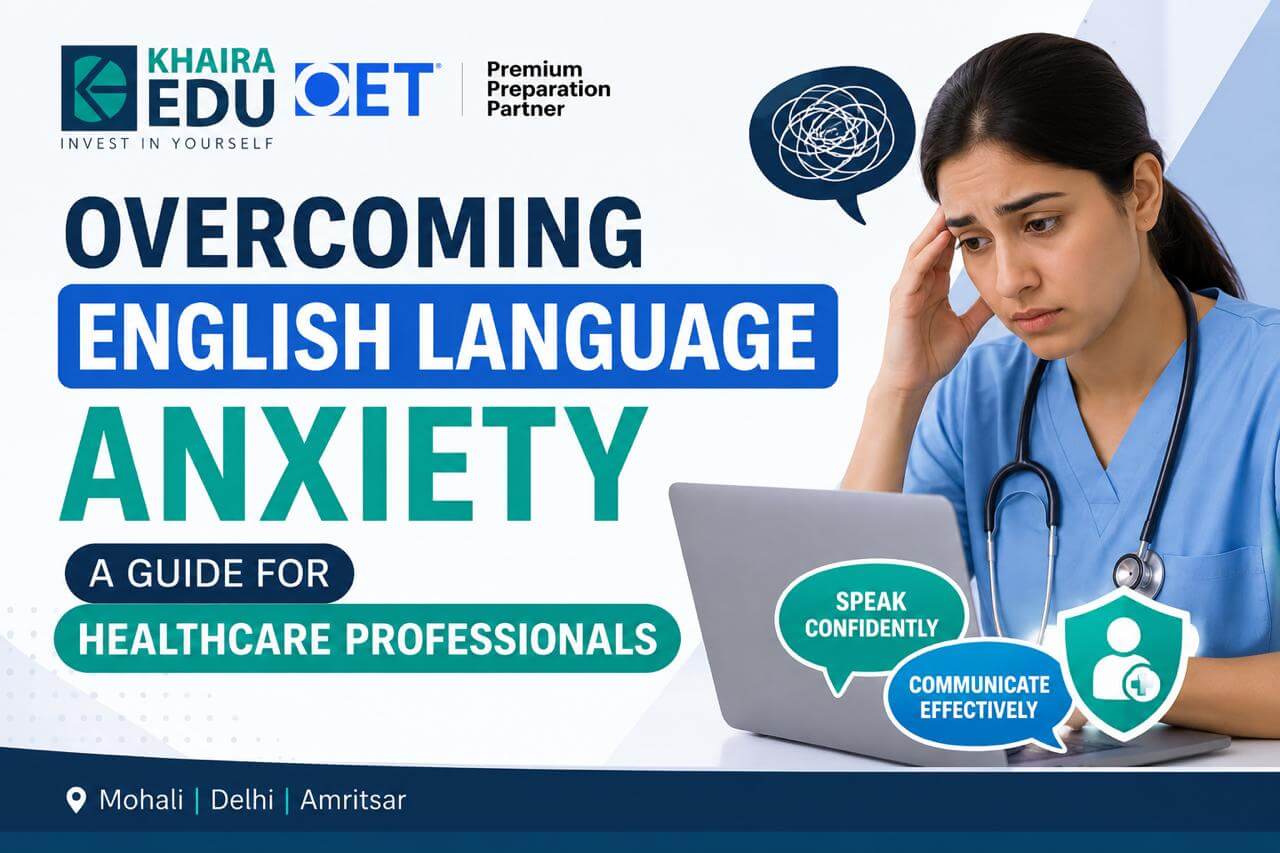
Overcoming English Language Anxiety: A Guide for Healthcare Professionals
I’ve spoken to countless OET candidates who feel confident in their clinical skills but lose that confidence the moment English becomes part of the equation. Interestingly, their anxiety rarely comes from a lack of knowledge. More often, it comes from the pressure of wanting to get everything right.
The reality is this: communication isn’t about perfection. It’s about connection. Patients don’t remember every word you use—they remember whether they felt heard, respected, and reassured.
If English language anxiety has been holding you back, here are a few ways to approach it differently.
1. Stop Measuring Your English Against Native Speakers
One of the quickest ways to lose confidence is by comparing yourself to people who have spoken English their entire lives.
It’s an unfair comparison.
Many native speakers use incomplete sentences, search for words, correct themselves mid-conversation, and rely on simple language every day. That’s how natural communication works.
Your goal isn’t to sound like a native speaker.
Your goal is to communicate safely, clearly, and professionally.
Those are very different standards.
When you stop chasing an impossible version of “perfect English,” you’ll notice your confidence starts to grow.
2. Trust the Healthcare Professional You Already Are
Something interesting happens during OET preparation.
Experienced clinicians suddenly forget how experienced they are.
They become so focused on grammar, vocabulary, and pronunciation that they stop thinking like healthcare professionals and start thinking like language learners.
But the qualities that make a good clinician don’t disappear simply because you’re speaking another language.
- You already know how to build rapport.
- You already know how to explain a treatment plan.
- You already know how to comfort someone who’s anxious or upset.
English is simply the tool you’re using to deliver those skills.
Don’t underestimate the experience you already bring into the room.
3. Don’t Let the Fear of Mistakes Silence You
Many candidates hesitate before almost every sentence because they’re mentally checking for grammar mistakes.
Ironically, that hesitation often affects fluency more than the mistake itself.
Here’s something worth remembering.
Patients are listening for meaning—not conducting a grammar test.
If your message is clear and compassionate, a small language error is unlikely to damage the interaction.
Confident communicators aren’t people who never make mistakes.
They’re people who don’t let small mistakes interrupt the conversation.
If you realise you’ve said something incorrectly, correct it naturally and move on.
The conversation matters more than the correction.
4. Think in Ideas, Not in Translation
This habit is incredibly common among healthcare professionals learning English.
A patient asks a question.
You translate it into your first language.
You prepare the answer.
Then you translate your response back into English.
By the time you’re ready to speak, you’ve already created unnecessary pressure.
Instead, train yourself to think in simple English.
You don’t need complicated vocabulary to communicate effectively.
For example, instead of trying to remember the perfect medical explanation, ask yourself:
“How would I explain this to someone’s parent or grandparent?”
That mindset naturally leads to clearer, more patient-friendly language.
And that’s exactly what OET is looking for.
5. Anxiety Shrinks When Your Focus Shifts
One thing I’ve noticed is that anxious candidates spend most of the consultation thinking about themselves.
- “Am I speaking correctly?”
- “Did I pronounce that word properly?”
- “What score will the examiner give me?”
Confident candidates focus somewhere else entirely.
- “Do they understand me?”
- “Have I answered their concern?”
- “What information do they need right now?”
That shift in attention changes everything.
The less you monitor yourself, the more naturally you’ll communicate.
6. Practice Conversations, Not Performances
There’s a difference between knowing English and using English.
Many candidates spend hours memorising vocabulary lists or reading grammar books but very little time having actual conversations.
Communication is a practical skill.
It improves through repetition.
Instead of memorising model answers, practise responding to unexpected questions.
Ask a friend to interrupt you.
Change the scenario halfway through.
Deal with an emotional patient.
Explain the same condition in three different ways.
Real conversations are unpredictable.
Your practice should be too.
7. Slow Down, It Makes You Sound More Confident
When anxiety takes over, the instinct is usually to speak faster.
It feels like you’re staying in control.
In reality, the opposite often happens.
Fast speech can make explanations harder to follow, increase pronunciation errors, and leave patients feeling overwhelmed.
Experienced healthcare professionals rarely rush important conversations.
They pause.
They emphasise key information.
They allow patients time to think and ask questions.
Try doing the same.
After explaining something, stop for a moment and ask:
- “Does that make sense?”
- “Would you like me to explain that another way?”
Those few seconds of silence often create a much better conversation.
8. Confidence Comes From Familiarity, Not Luck
People often say,
“I hope I feel confident on exam day.”
Confidence doesn’t usually appear overnight.
It develops after you’ve handled similar situations again and again.
The first role-play feels awkward.
The tenth feels manageable.
The fiftieth feels natural.
That’s why consistent practice matters far more than occasional intensive study.
Every conversation adds another layer of confidence.
9. Be Kind to Yourself During the Learning Process
Healthcare professionals are often their own toughest critics.
A single pronunciation mistake can overshadow an otherwise excellent conversation.
But think about how you treat your patients.
You encourage progress.
You don’t expect perfection after one appointment.
Apply that same mindset to yourself.
Celebrate the improvements you’ve made, however small they seem.
Confidence grows much faster when progress is recognised instead of ignored.
10. Remember the Bigger Picture
It’s easy to become consumed by the exam.
The speaking score.
The writing score.
The countdown to test day.
But OET isn’t the destination.
It’s one milestone in a much bigger professional journey.
The communication skills you’re building today will stay with you long after the exam is over.
They’ll help you explain diagnoses more clearly.
Support anxious families.
Build stronger relationships with colleagues.
And most importantly, provide better care to your patients.
That’s a goal worth working towards.
Final Thoughts
English language anxiety isn’t a sign that you’re incapable. In many cases, it’s simply a sign that you care deeply about doing your job well.
The challenge isn’t to eliminate every moment of nervousness. It’s to stop letting nervousness control the conversation.
Every healthcare professional starts somewhere.
Every confident communicator was once uncertain.
With enough practice, you’ll notice something unexpected.
You’ll stop worrying about finding the perfect sentence.
Instead, you’ll focus on understanding the person sitting in front of you.
And when that happens, your English won’t just improve.
Your communication will too.
Because in healthcare, the most memorable conversations aren’t the ones with perfect grammar, they’re the ones where patients feel listened to, understood, and genuinely cared for.