

A patient avoids eye contact while you explain a procedure.
Are they disengaged?
A family member answers every question on behalf of an older patient.
Are they being controlling?
A patient repeatedly refuses pain relief despite appearing uncomfortable.
Do they not understand the treatment?
Perhaps.
Or perhaps you are interpreting somebody else’s behaviour through your own cultural expectations.
This is what makes cultural sensitivity in healthcare more demanding than simply being respectful to people from different countries. Healthcare professionals do not enter clinical conversations as culturally neutral observers. We bring our own assumptions about politeness, independence, family involvement, pain, privacy, authority, touch, eye contact and even what a “good patient” looks like.
Patients bring theirs.
Good cross-cultural communication begins when we recognise that neither side’s interpretation should automatically be treated as the obvious one.
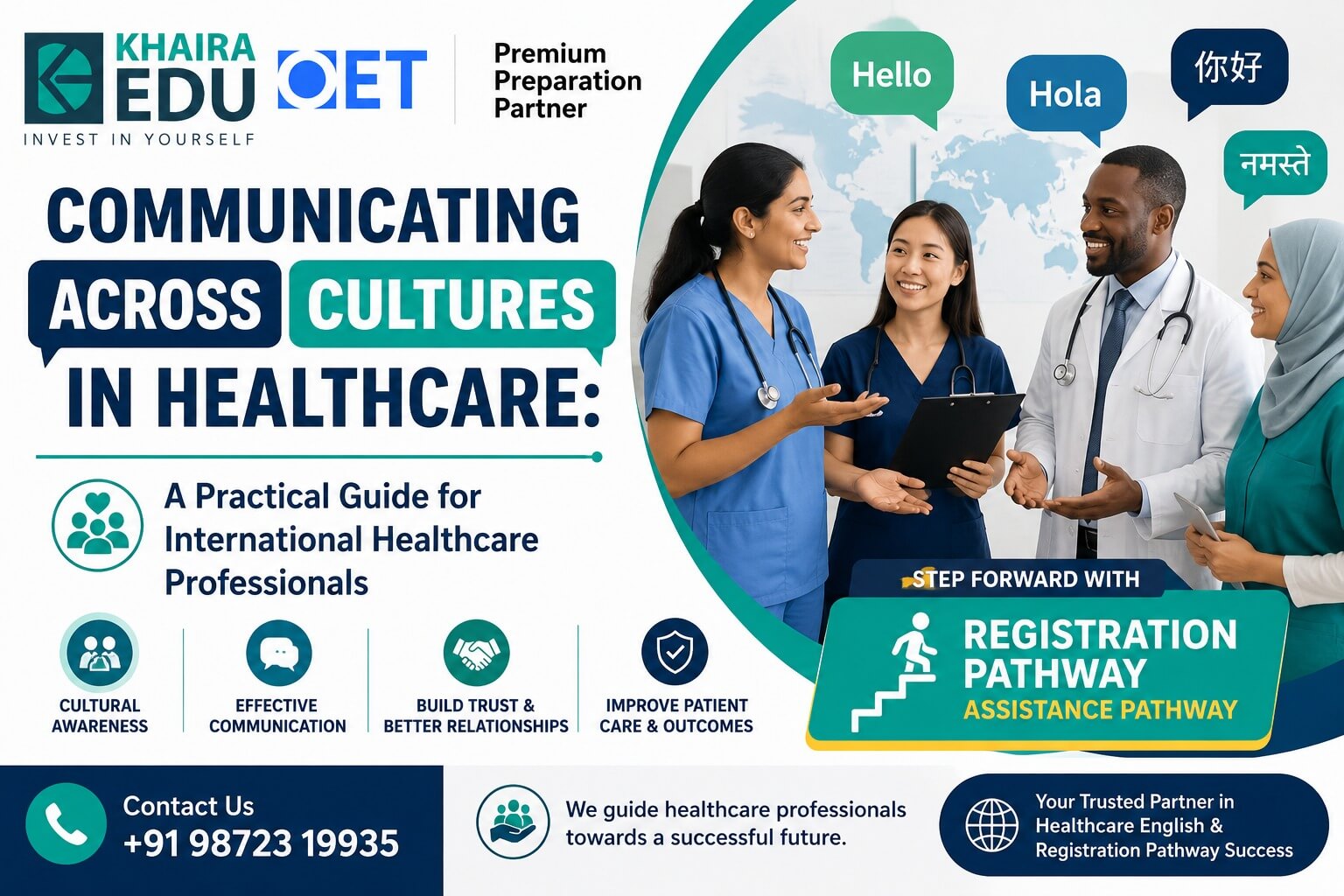
Communicating Across Cultures in Healthcare
For internationally qualified healthcare professionals moving to Australia, New Zealand, the UK, Ireland, Canada or the USA, this skill matters in two directions. You will care for patients whose backgrounds may differ considerably from your own, while simultaneously adapting to a healthcare culture that may itself communicate differently from the system in which you trained.
That is not simply a language adjustment.
It is a professional one.
Culture Is More Than Nationality
One of the first mistakes in discussions about cultural competence in nursing is reducing culture to country.
A patient is Indian, therefore they believe this.
A patient is British, therefore they prefer that.
A patient is Muslim, Chinese, Māori, Irish, Punjabi, Filipino or Nigerian, so certain assumptions follow.
Real people are considerably less tidy.
Culture can be shaped by nationality, language, religion, family, generation, migration history, education, profession, socioeconomic circumstances and community. Two people born in the same town can have completely different ideas about illness, authority and healthcare.
There is another culture in the room too: the culture of healthcare itself.
Healthcare professionals acquire their own vocabulary, routines and assumptions. We learn what counts as important information, how quickly a clinical conversation should progress and which questions feel ordinary because we have asked them hundreds of times.
To the patient, they may not feel ordinary at all.
So culturally responsive communication is not about memorising what “people from a particular culture” supposedly do.
It is about becoming less certain that your own way is the default.
Cultural Sensitivity Starts With Self-Awareness
Imagine a nurse who believes that a cooperative patient should look at them while speaking.
A patient repeatedly looks down.
The nurse may interpret this as reluctance, dishonesty or lack of engagement.
But eye contact does not carry the same social meaning everywhere. In some families or cultures, prolonged direct eye contact with someone perceived as older or in authority may feel uncomfortable or disrespectful.
Now reverse the situation.
A healthcare professional who has been taught to show respect through formality may move into a workplace where patients and colleagues routinely use first names. What feels professional to the nurse may initially appear distant to someone else.
Neither example requires us to create rigid rules about eye contact or names.
The lesson is more useful:
Before interpreting a behaviour, ask yourself whether you are also interpreting it culturally.
That habit prevents a great deal of unnecessary misunderstanding.
Do Not Turn Cultural Awareness Into Cultural Stereotyping
There is an irony in cultural training.
Poor training can actually make healthcare professionals more stereotypical.
You learn that “Culture A values family”, “Culture B avoids eye contact” and “Culture C prefers traditional remedies”.
Then a patient enters the room and, instead of meeting an individual, you meet the cultural profile you were expecting.
That is not cultural competence.
Useful cultural knowledge can alert us to possibilities. It should never tell us what an individual patient believes before they have had the opportunity to tell us themselves.
Compare:
“In your culture, families usually make these decisions together, don’t they?”
with:
“Would you prefer to make this decision yourself, or would you like someone from your family involved?”
The second approach does not pretend culture is irrelevant.
It simply allows the patient to define what culture means for them.
A helpful rule for cross-cultural healthcare communication is:
Use cultural knowledge to improve your questions, not to predetermine the answers.
The Same Behaviour Can Mean Different Things
Healthcare professionals constantly interpret non-verbal communication.
We notice silence.
Facial expression.
Personal distance.
Touch.
Tone.
Posture.
Eye contact.
But non-verbal behaviour is particularly vulnerable to cultural misinterpretation.
Silence, for example, can mean many things.
A patient may be thinking carefully.
They may be showing respect.
They may disagree but feel uncomfortable contradicting a healthcare professional.
They may not have understood the question.
Or they may simply be quiet.
The safest response is rarely to assign meaning immediately.
You can explore:
“You’ve gone a little quiet. Is there something you’re thinking about?”
Or:
“Would you like a little time to think about that?”
Similarly, someone smiling while discussing distressing information is not necessarily unconcerned. Someone who speaks loudly is not automatically aggressive. Someone who prefers greater physical distance is not necessarily unfriendly.
Observe the behaviour. Be cautious about interpreting the meaning.
That distinction is central to culturally sensitive communication.
“Yes” Does Not Always Mean Agreement
This is particularly important for healthcare professionals working across languages and cultures.
Imagine explaining a medication plan.
“You’ll take this tablet twice a day. Is that okay?”
The patient nods.
“Yes.”
It is tempting to conclude that the patient understands and agrees.
But “yes” can perform several social functions. It may indicate understanding. It may indicate politeness. It may mean “I hear you”. It may signal reluctance to challenge someone regarded as an authority.
Language proficiency complicates this further. A patient may understand everyday English reasonably well while struggling with medical information.
Instead of relying solely on agreement, check understanding in a way that does not embarrass the patient:
“Just so I know I’ve explained it clearly, could you tell me how you’ll take the tablets when you get home?”
Now the healthcare professional is checking the communication itself rather than testing the patient’s intelligence or English.
This is good healthcare communication in any culture. Cross-cultural situations simply make its importance easier to see.
Family Involvement Can Mean Very Different Things
Many internationally qualified healthcare professionals encounter striking differences in expectations around family involvement.
In some families, illness is approached collectively. Relatives attend consultations, participate actively in discussions and expect to support important decisions.
In other settings, healthcare practice may place strong emphasis on speaking directly with the patient and establishing what the patient wants.
These positions do not have to become adversaries.
Suppose an adult patient’s son answers every question.
An irritated healthcare professional might say:
“I need the patient to answer for herself.”
Sometimes that boundary may indeed need to be made clear.
But beginning with curiosity can be more productive:
“I can see that you’re very involved in your mother’s care. Mrs Khan, are you happy for your son to be involved while we talk?”
This achieves something important.
It neither excludes the family automatically nor assumes that family participation should override the patient’s wishes.
It brings the patient back into the centre of the conversation.
The broader lesson is that family-centred and person-centred communication do not always have to be opposites. The healthcare professional needs to establish what involvement the individual patient actually wants.
Health Beliefs Affect More Than Treatment Choices
Patients do not necessarily understand illness through the same explanatory model as the healthcare professional.
One person may understand hypertension primarily as a medical condition requiring long-term management.
Another may associate it strongly with stress.
Another may believe particular foods caused it.
Someone else may combine prescribed treatment with traditional medicine, prayer or remedies used within their family.
Immediately dismissing an unfamiliar belief can end the useful part of the conversation.
Consider:
“That remedy doesn’t work. You should stop taking it.”
Even where there are legitimate clinical concerns, beginning this way may make the patient less likely to tell you what else they are taking.
Compare:
“Can you tell me a little more about what you’re using and how you feel it helps?”
You now have information.
That matters because culturally sensitive healthcare is not about agreeing with every belief. Clinical recommendations still need to remain evidence-based and within professional scope.
The difference lies in understanding the patient’s perspective before attempting to influence it.
Ask About What Matters Instead of Guessing
Certain clinical situations particularly benefit from open questions.
Food:
“Are there any foods you avoid for cultural, religious or personal reasons?”
Personal care:
“Do you have any preferences about who assists you with personal care?”
Religious practice:
“Is there anything related to your faith or daily practices that you’d like us to be aware of while you’re here?”
Family:
“Who would you like involved in discussions about your care?”
Names:
“What would you prefer us to call you?”
Treatment concerns:
“Is there anything about this treatment that conflicts with your beliefs or concerns you?”
None of these questions requires the healthcare professional to become an expert in every culture represented in the population.
That would be impossible.
The skill is knowing when to make space for information you may not know to ask about otherwise.
Language Barriers Require More Than Speaking Slowly
Speaking more slowly can help.
It is not an interpreting service.
When a patient has limited proficiency in the language being used for significant clinical communication, healthcare professionals need to follow their organisation’s procedures for appropriate language support and professional interpreting.
This is particularly important when communication involves complex information, significant decisions, consent, medication instructions or safety concerns.
A relative may appear to be the convenient interpreter.
But relatives may summarise rather than translate, omit sensitive information, answer for the patient or struggle with medical terminology. There may also be information the patient does not wish to discuss through a family member.
The exact interpreting requirements vary between healthcare systems and organisations, so professionals should follow current local policy.
There is also a smaller but common problem: healthcare professionals assuming that louder English is clearer English.
It isn’t.
If the barrier is vocabulary, volume does not solve it.
Use shorter sentences. Avoid unnecessary jargon. Explain one idea at a time. Check understanding. Rephrase rather than simply repeating the same sentence more loudly.
Some Questions May Feel More Sensitive Than You Expect
Healthcare professionals become accustomed to asking personal questions because the information is clinically relevant.
Sexual history.
Pregnancy.
Alcohol.
Drug use.
Mental health.
Family relationships.
Domestic circumstances.
These questions may feel routine to the professional asking them.
They may not feel routine to the patient.
Cultural, religious and personal factors can influence how comfortable someone is discussing particular subjects, especially with a healthcare professional of another gender or when relatives are present.
Avoiding the topic entirely is not the solution when information is clinically necessary.
Context helps.
For example:
“I ask everyone with these symptoms a few questions about sexual health because the answers can affect which tests we recommend. Is it okay if I ask you those now?”
Or:
“Some of the next questions are quite personal, but they are part of the assessment we routinely do.”
The patient now understands why the question is being asked.
Sensitivity does not mean becoming vague about clinically important information.
It means making the purpose of the conversation clear and preserving dignity while obtaining what is needed.
Patient-Centred Care Can Feel Unfamiliar to International Professionals Too
Cross-cultural communication does not only concern the patient’s culture.
International healthcare professionals are also adapting.
A nurse may move from a healthcare environment in which clinicians generally direct decisions to one where patients are expected to participate more explicitly in choices about their care.
A professional accustomed to formal titles may enter a workplace where first names are common.
Someone trained not to contradict senior colleagues may find themselves in a system where raising a concern is expected.
A clinician accustomed to relatives being closely involved may need to become more deliberate about establishing an adult patient’s preferences and privacy.
This is why overseas healthcare cultural training should not simply teach professionals “how patients in another country behave”.
The healthcare professional is undergoing cultural adaptation too.
The useful questions become:
What does professional respect look like here?
How directly are concerns expressed?
How are patients involved in decisions?
How does the team communicate across hierarchy?
When is clarification expected rather than seen as challenging authority?
What assumptions from my previous workplace am I carrying into this one?
Those questions are considerably more valuable than trying to imitate an accent or memorise local expressions.
Cultural Humility May Be More Useful Than Cultural Certainty
There is no point at which a healthcare professional can declare:
I now understand all cultures.
Nor should that be the goal.
A more realistic professional stance is:
I know that culture can affect this interaction.
I know that I also bring assumptions into it.
I will remain curious enough to check rather than presume.
That approach is sometimes described as cultural humility, and it captures something that the language of “competence” can miss.
Competence can sound as though culture is a body of information to master.
Human beings keep ruining that idea by being individuals.
The better skill is remaining capable of adjusting.
A Practical Example: From Assumption to Exploration
Imagine an older patient admitted with poorly controlled diabetes. Her adult daughter attends every conversation and repeatedly responds for her.
A healthcare professional may privately conclude:
The daughter is dominating the patient.
Perhaps she is.
But there are several other possibilities.
The patient may have asked her daughter to speak because she feels more comfortable doing so.
She may find healthcare terminology difficult.
Family participation may be normal and reassuring to her.
She may have hearing difficulties.
Or she may indeed want more opportunity to speak for herself.
Instead of diagnosing the family dynamic from five minutes of observation:
“Mrs Lee, I’m very happy for your daughter to be involved if that’s what you prefer. I’d also like to make sure I’m hearing directly from you. How would you like us to manage these conversations?”
That question does not require cultural expertise.
It requires cultural curiosity plus patient-centred communication.
And it gives the only person who can truly answer the question an opportunity to do so.
Common Cross-Cultural Communication Mistakes
Some habits are particularly worth watching:
assuming nationality tells you what a patient believes;
treating your own communication style as culturally neutral;
interpreting limited eye contact as dishonesty or disengagement;
confusing politeness with genuine agreement;
assuming family involvement is either always helpful or always inappropriate;
using relatives automatically when significant interpretation is required;
dismissing traditional or religious health beliefs before understanding them;
avoiding necessary sensitive questions because you fear causing offence;
speaking more loudly when the real problem is comprehension;
assuming conversational English means the patient understands medical language;
treating cultural sensitivity as being agreeable rather than remaining respectful while exercising professional judgement.
Perhaps the most damaging mistake, though, is assuming that because you intended to be respectful, the communication must have been successful.
Intent matters.
Impact matters too.
Frequently Asked Questions
What is cultural sensitivity in healthcare?
Cultural sensitivity in healthcare means recognising that patients and healthcare professionals may bring different beliefs, communication styles, values and expectations into a clinical interaction. It involves adapting communication respectfully without stereotyping the individual.
Why is cultural competence important for nurses?
Nurses communicate with patients during assessment, medication administration, personal care, education, discharge and emotionally difficult situations. Cultural differences can affect how patients express symptoms, understand illness, involve family members and respond to healthcare advice, making culturally responsive communication an important nursing skill.
How can healthcare professionals avoid cultural stereotypes?
Use knowledge about cultural differences as a reason to ask better questions rather than as evidence that an individual patient must think or behave in a particular way. Ask about preferences and beliefs directly where they are relevant.
How should nurses communicate with patients who have limited English?
Use clear language, manageable amounts of information and frequent checks of understanding. When a significant language barrier exists, follow the employer’s current policy regarding professional interpreters and language support, particularly for complex, consent-related or safety-critical communication.
What communication skills are important for internationally qualified nurses?
Alongside language proficiency, internationally qualified nurses benefit from patient-centred questioning, active listening, clarification, checking understanding, professional assertiveness, culturally responsive communication and the ability to adapt to the communication conventions of their new healthcare system.
Cultural Communication Is Less About Knowing Every Answer
International healthcare work brings professionals into contact with people whose experiences, expectations and assumptions may be very different from their own.
The answer is not to memorise a catalogue of cultures.
Nor is it to become so nervous about saying the wrong thing that meaningful questions are avoided altogether.
Good cross-cultural communication in healthcare is far more practical.
Notice when an assumption may be influencing your interpretation.
Ask rather than guess.
Explain rather than presume.
Check rather than rely on a polite “yes”.
Respect family relationships without losing sight of the individual patient.
Remain clinically clear without dismissing beliefs you do not immediately understand.
And perhaps most importantly, remember that cultural awareness runs in both directions.
When an internationally qualified healthcare professional moves to a new healthcare system, the patient is not the only person bringing a culture into the room.
So are you.
Recognising that is not a weakness in professional judgement.
It is where more thoughtful judgement begins.
To learn more about how our structured courses prepare you for every OET sub-test, visit Khaira Education.