

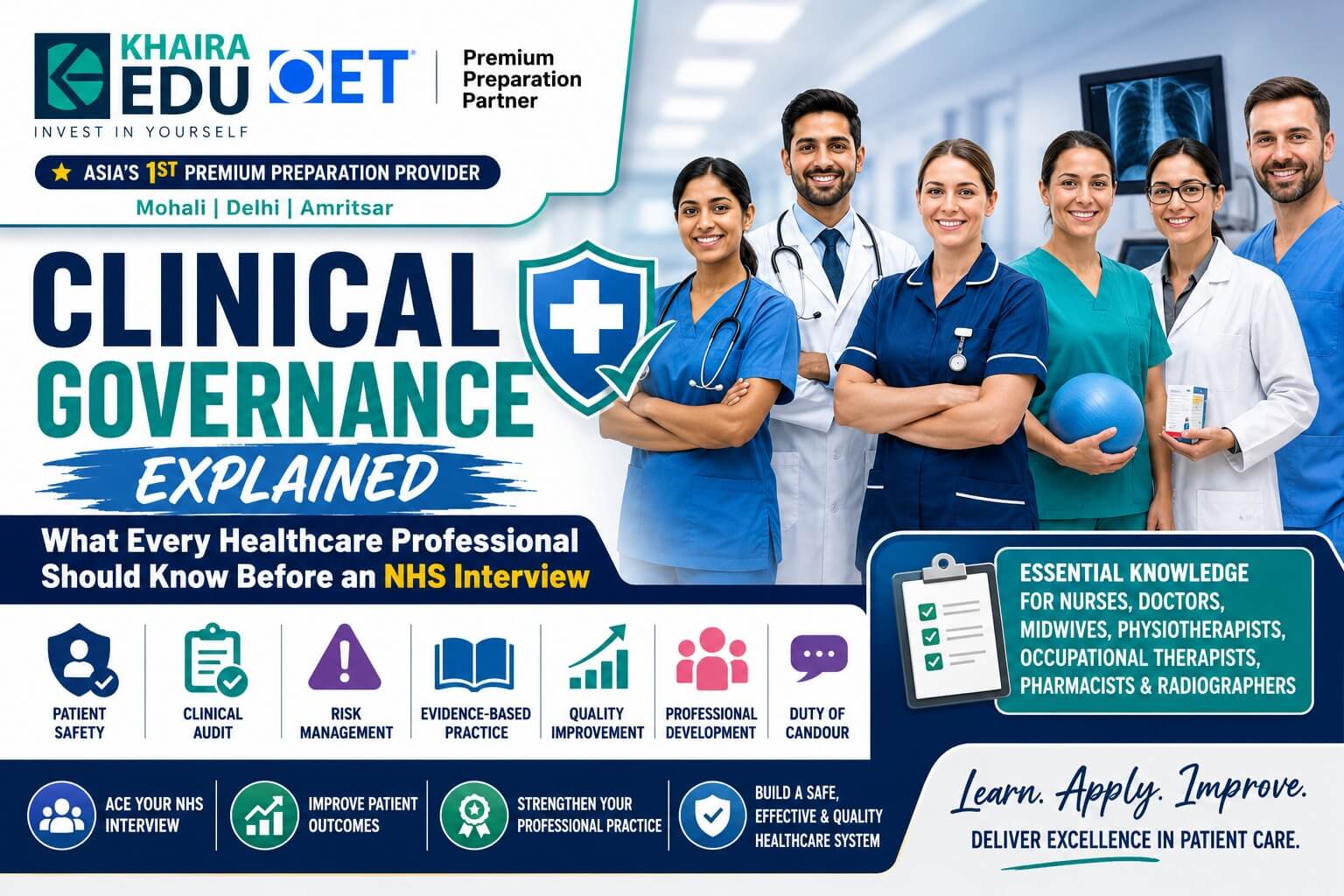
Learn what clinical governance means, why it matters for NHS interviews, and how nurses, doctors, physiotherapists, pharmacists, midwives, occupational therapists, and radiographers can confidently discuss patient safety, audit, and quality improvement during their UK registration journey.
Clinical Governance Explained: What Every Healthcare Professional Should Know Before an NHS Interview
Whether you are preparing for OET, pursuing NMC registration as a nurse, GMC registration as a doctor, HCPC registration as a physiotherapist, occupational therapist or radiographer, or GPhC registration as a pharmacist, there is one topic you are almost certain to encounter during your NHS job search: clinical governance.
Many healthcare professionals hear the term during interviews but are unsure how to explain it confidently. Others assume it only applies to managers or senior clinicians. In reality, clinical governance affects every healthcare professional involved in patient care.
From reporting incidents and maintaining patient safety to participating in audits and following evidence-based practice, clinical governance forms the foundation of modern healthcare systems across the UK.
It is also one of the most frequently assessed topics during NHS interviews, particularly for nurses, doctors, midwives, physiotherapists, occupational therapists, pharmacists, and radiographers seeking employment within the NHS.
At Khaira Education Services, healthcare professionals receive expert guidance from Gurleen Khaira, bestselling author and co-author of eight OET preparation books, certified Master Trainer, certified Career Coach, healthcare consultant, OET expert, and Medical English communication specialist. Khaira Education Services is Asia’s first Premium Preparation Provider listed on the official OET website and provides both online and offline training for healthcare professionals.
This guide explains clinical governance in simple terms, explores why it matters during your registration journey, and outlines the questions you may encounter during NHS interviews.
Quick Summary
Clinical governance is the framework through which healthcare organisations continuously improve the quality and safety of patient care.
It includes:
- Patient safety
- Clinical audit
- Risk management
- Evidence-based practice
- Quality improvement
- Incident reporting
- Professional development
- Duty of candour
Healthcare professionals are expected to understand these principles during NHS interviews and throughout their careers.
What Is Clinical Governance?
Clinical governance is a framework that ensures healthcare organisations maintain and continuously improve the quality of patient care.
In simple terms:
Clinical governance ensures healthcare professionals deliver safe, effective, evidence-based, and patient-centred care while continually learning and improving.
Rather than focusing solely on individual performance, clinical governance promotes systems that support accountability, learning, transparency, and patient safety.
Why Does Clinical Governance Matter During Your UK Registration Journey?
Many healthcare professionals first encounter clinical governance during the registration and recruitment process.
For Nurses
Clinical governance is relevant throughout:
- OET Preparation
- NMC Registration
- CBT Preparation
- OSCE Preparation
- NHS Band 5 Interviews
- NHS Nursing Careers
Interview panels often ask nurses about patient safety, audits, safeguarding, incident reporting, and quality improvement.
For Doctors
Clinical governance is central to:
- GMC Registration
- PLAB Preparation
- NHS Trust Grade Interviews
- Specialty Recruitment
Doctors are often expected to demonstrate understanding of audit, reflective practice, patient safety, and clinical leadership.
For Physiotherapists, Occupational Therapists and Radiographers
Professionals pursuing HCPC registration frequently encounter questions about:
- Risk management
- Patient-centred care
- Evidence-based practice
- Clinical governance
- Service improvement
For Pharmacists
Clinical governance is closely linked to:
- GPhC Registration
- Medicines Management
- Prescribing Safety
- Medication Error Prevention
- NHS Pharmacy Interviews
Regardless of profession, understanding clinical governance demonstrates professionalism and commitment to patient safety. This is closely connected to the healthcare communication skills NHS employers look for across all disciplines.
The Main Pillars of Clinical Governance
Patient Safety
Patient safety is at the heart of clinical governance. Healthcare professionals are expected to:
- Identify risks
- Escalate concerns
- Report incidents
- Learn from mistakes
- Promote safer systems
Example: A nurse identifies a potential medication error before administration and follows local reporting procedures to prevent patient harm.
Clinical Audit
Clinical audit measures current practice against agreed standards. Its purpose is to identify opportunities for improvement. Examples include:
- Sepsis pathway audits
- Medication safety audits
- Documentation audits
- Infection control audits
Healthcare professionals preparing for NHS interviews are often asked whether they have participated in audits.
Evidence-Based Practice
Healthcare decisions should be informed by current research, clinical expertise, and patient preferences. Evidence-based practice ensures patients receive care supported by the latest available evidence.
Risk Management
Risk management focuses on identifying and reducing potential threats to patient safety. Examples include:
- Falls prevention
- Infection control
- Medication safety
- Equipment checks
Healthcare professionals are expected to recognise risks and escalate concerns appropriately.
Quality Improvement
Quality improvement involves making healthcare services safer, more effective, and more efficient. Examples include:
- Reducing waiting times
- Improving patient education
- Enhancing communication processes
- Streamlining discharge planning
Professional Development
Continuous learning is a key component of clinical governance. Healthcare professionals should:
- Attend training
- Maintain competencies
- Reflect on practice
- Participate in continuing professional development
Clinical Governance vs Clinical Audit: What’s the Difference?
This is a common NHS interview question.
Clinical Governance is the overall framework for improving healthcare quality and patient safety.
Clinical Audit is a specific tool used within clinical governance to assess and improve practice.
Think of clinical governance as the umbrella and clinical audit as one of the activities underneath it.
Common Clinical Governance Interview Questions for Nurses
Healthcare professionals frequently search for NHS Band 5 interview questions, NMC interview questions, and clinical governance questions for nurses. Developing confident answers in clear, professional English is just as important as knowing the content — something covered in depth during OET Speaking preparation for non-native speakers.
Common examples include:
- What is clinical governance?
- Why is clinical governance important?
- What would you do if you identified a patient safety concern?
- Have you participated in a clinical audit?
- What is duty of candour?
- How do you contribute to quality improvement?
Common Clinical Governance Interview Questions for Doctors
Frequently searched topics include GMC interview questions, NHS doctor interview questions, and clinical governance for doctors. Understanding why OET is mandatory for healthcare professionals working abroad also helps doctors contextualise governance expectations in UK practice.
Common examples include:
- Describe your involvement in clinical audit.
- What role does reflective practice play in clinical governance?
- How would you respond to a clinical incident?
- What is the purpose of incident reporting?
- How do you apply evidence-based medicine in your practice?
Common Clinical Governance Interview Questions for Physiotherapists, Occupational Therapists, Pharmacists and Radiographers
Examples include:
- How do you ensure patient safety?
- How do you maintain professional competence?
- Can you describe a service improvement project?
- How do you use evidence-based practice?
- What would you do if you identified a clinical risk?
- How do you contribute to quality improvement?
Related Topics Every Healthcare Professional Should Understand
Clinical governance is closely linked to several other NHS interview topics. Candidates who understand the connections between these areas often perform more confidently during interviews.
- NHS Values
- Patient Safety
- Duty of Candour
- Clinical Audit
- Reflective Practice
- Quality Improvement
- Evidence-Based Practice
- Safeguarding
- Risk Management
- Healthcare Communication Skills
- Multidisciplinary Teamwork
Why Clinical Governance Matters Beyond Interviews
Many candidates focus on clinical governance only because it appears in interviews. However, its importance extends far beyond recruitment.
Clinical governance influences:
- Patient outcomes
- Professional accountability
- Service quality
- Regulatory compliance
- Team performance
- Public trust
Whether you are working as a nurse registered with the NMC, a doctor registered with the GMC, a physiotherapist, occupational therapist, or radiographer registered with the HCPC, or a pharmacist registered with the GPhC, clinical governance will remain a fundamental part of your professional practice.
Top Clinical Governance Concepts at a Glance
| Concept | Why It Matters |
|---|---|
| Patient Safety | Reduces harm |
| Clinical Audit | Measures quality |
| Risk Management | Prevents incidents |
| Evidence-Based Practice | Improves outcomes |
| Quality Improvement | Enhances services |
| Duty of Candour | Promotes transparency |
| Reflective Practice | Encourages learning |
| Professional Development | Maintains competence |
3 Key Takeaways
1. Clinical Governance Is a Core NHS Interview Topic
Healthcare professionals across all disciplines are commonly asked about clinical governance during NHS interviews.
2. Patient Safety Is the Central Theme
Most elements of clinical governance ultimately focus on delivering safe, effective, patient-centred care.
3. Understanding Clinical Governance Supports Your Entire UK Career Journey
From OET preparation and choosing the right English test through to registration, interviews, and professional practice, clinical governance remains highly relevant at every stage.
Conclusion
Clinical governance is far more than an interview topic. It is the framework that helps healthcare organisations deliver safe, effective, and continuously improving care.
Whether you are preparing for NMC registration, GMC registration, HCPC registration, GPhC registration, NHS interviews, or healthcare employment in the UK, understanding clinical governance will strengthen both your professional knowledge and your interview performance.
At Khaira Education Services, healthcare professionals receive guidance from Gurleen Khaira, bestselling author and co-author of eight OET preparation books, certified Master Trainer, healthcare consultant, and Medical English communication specialist. Through OET preparation and healthcare communication skills training, NHS interview preparation, and international registration pathway guidance, healthcare professionals can develop the competencies needed to succeed in modern healthcare environments.
Understanding clinical governance is not about memorising definitions. It is about understanding how quality, safety, accountability, and continuous improvement influence every patient interaction.
Frequently Asked Questions
- What is clinical governance in simple terms?
- Clinical governance is the framework through which NHS organisations continuously improve the quality and safety of patient care. It covers patient safety, clinical audit, risk management, evidence-based practice, and professional development.
- Why is clinical governance important for NHS interviews?
- NHS interviewers assess whether candidates understand how safe, effective care is maintained and improved. Clinical governance questions are common across nursing, doctor, and allied health interviews.
- What is the difference between clinical governance and clinical audit?
- Clinical governance is the overall quality and safety framework. Clinical audit is one specific tool used within that framework to measure and improve practice against agreed standards.
- What is duty of candour in the NHS?
- Duty of candour is the professional and legal obligation for healthcare professionals and organisations to be open and honest with patients when something goes wrong with their care.
- How should I answer clinical governance questions in an NHS interview?
- Use real examples from your practice. Demonstrate understanding of patient safety, incident reporting, audit, and reflective practice. Structure your answers using frameworks like STAR to keep responses clear and focused.
Ready to prepare for your NHS interview with confidence?
Khaira Education Services offers expert OET coaching, healthcare communication training, and NHS interview preparation. Explore our courses or book a free consultation today.