

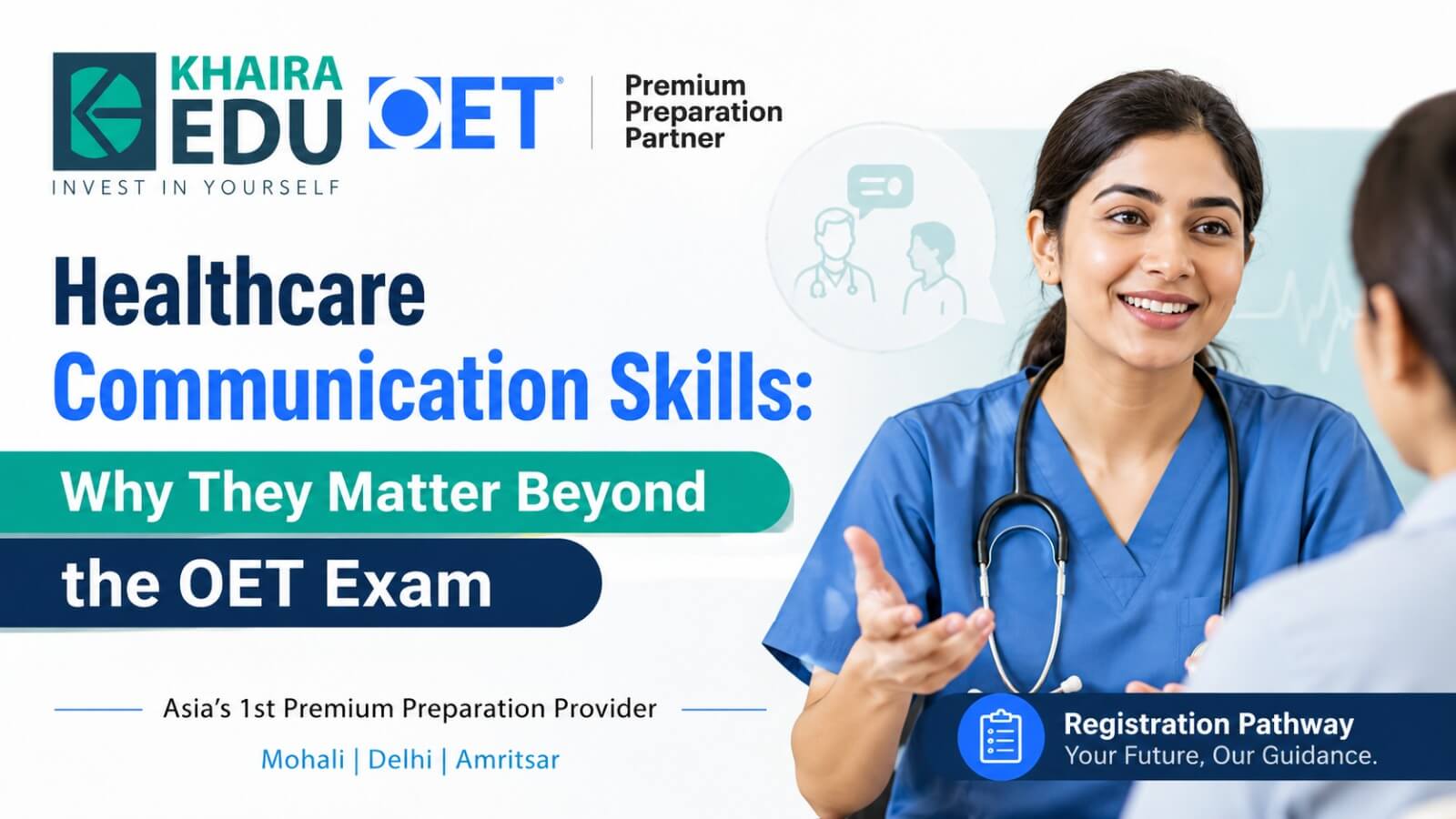
Many healthcare professionals first begin actively developing their communication skills while preparing for the OET exam. During preparation, candidates learn how to gather information, explain procedures, demonstrate empathy, provide reassurance, and communicate professionally with patients.
The reality is quite different.
The communication skills assessed in OET reflect the same skills healthcare professionals use every day in hospitals, clinics, aged care facilities, rehabilitation centres, community healthcare settings, and multidisciplinary teams around the world.
Whether you are a nurse, doctor, pharmacist, physiotherapist, midwife, healthcare assistant, or allied health professional, strong communication skills influence nearly every aspect of your professional practice.
At Khaira Education Services, healthcare professionals receive expert guidance from Gurleen Khaira, bestselling author and co-author of eight OET preparation books, certified Master Trainer, certified Career Coach, healthcare consultant, OET expert, and Medical English communication specialist. Khaira Education Services is Asia’s first Premium Preparation Provider listed on the official OET website and provides both online and offline training for healthcare professionals.
In this article, we explore why healthcare communication skills matter far beyond examination success and how they can shape your professional future.
Healthcare Communication Skills: Why They Matter Beyond the OET Exam
Strong healthcare communication skills help professionals:
- Improve patient safety
- Build trust and rapport
- Reduce misunderstandings
- Support better clinical outcomes
- Collaborate effectively with healthcare teams
- Manage difficult conversations confidently
- Succeed during interviews and workplace assessments
- Adapt more easily to healthcare systems abroad
- Enhance career progression opportunities
What Are Healthcare Communication Skills?
Healthcare communication skills refer to the ability to exchange information clearly, professionally, and compassionately within healthcare environments.
These skills include:
- Active listening
- Patient-centred communication
- Empathy
- Explaining information clearly
- Obtaining informed consent
- Providing instructions
- Handling difficult conversations
- Collaborating with colleagues
- Delivering safe handovers
Communication is not simply about speaking English. It is about ensuring the other person understands the message accurately.
A healthcare professional may have excellent clinical knowledge, but if patients do not understand their instructions, treatment outcomes may suffer.
Why Are Communication Skills Considered a Clinical Skill?
Communication is often described as a “soft skill,” but in reality, it is a clinical skill.
Every day, healthcare professionals make decisions based on information gathered from patients. If communication breaks down, important details can be missed.
Consider a patient presenting with chest pain. A clinician who asks effective questions may identify a potentially life-threatening condition quickly. A clinician who fails to explore symptoms thoroughly may miss critical information.
Good communication supports:
- Accurate assessment
- Clinical decision-making
- Risk management
- Patient safety
- Treatment adherence
This is why communication skills are assessed during licensing examinations, workplace inductions, interviews, and professional practice evaluations. If you are preparing for your OET course, building these skills forms an essential part of your preparation.
How Do Communication Skills Improve Patient Safety?
Patient safety depends heavily on clear communication. Many healthcare incidents involve misunderstandings rather than a lack of clinical knowledge.
Examples include:
- Incorrect medication administration
- Incomplete patient histories
- Misinterpreted instructions
- Poor handovers
- Missed warning signs
Simple communication techniques can significantly reduce risks.
For example, instead of saying:
“Take this medication regularly.”
A healthcare professional might say:
“Take one tablet twice daily, once in the morning and once in the evening.”
Clear, specific instructions reduce ambiguity and improve patient understanding.
Why Is Building Rapport Important in Healthcare?
Patients are more likely to trust healthcare professionals who make them feel respected, listened to, and understood.
Rapport influences:
- Patient satisfaction
- Information sharing
- Treatment compliance
- Anxiety reduction
- Healthcare experiences
A patient who feels rushed may withhold important information. A patient who feels comfortable is more likely to discuss symptoms, concerns, fears, and treatment preferences openly.
Simple phrases such as:
- “Thank you for sharing that with me.”
- “I understand your concerns.”
- “Please take your time.”
can make a significant difference to the patient experience.
How Do Communication Skills Improve Clinical Outcomes?
Healthcare communication directly influences outcomes. Patients who understand their condition and treatment plan are more likely to:
- Take medications correctly
- Attend follow-up appointments
- Follow lifestyle recommendations
- Participate in shared decision-making
Research consistently shows that effective communication improves patient engagement and treatment adherence. For example, a diabetic patient who clearly understands how medication, diet, and exercise work together is more likely to manage their condition successfully.
Good communication transforms information into action.
Why Are Communication Skills Essential for Working Abroad?
Healthcare professionals moving abroad often discover that communication expectations differ from those in their home country. In countries such as the United Kingdom, Australia, New Zealand, Ireland, Canada, and the United States, healthcare communication is typically highly patient-centred.
Patients are encouraged to ask questions, participate in decisions, express concerns, and discuss preferences. Healthcare professionals are expected to use plain language, demonstrate empathy, confirm understanding, and encourage patient involvement.
Strong communication skills help international healthcare professionals adapt more confidently to these workplace expectations. Learn more about how OET supports international registration pathways and prepares you for working in English-speaking healthcare environments.
How Do Communication Skills Affect Teamwork?
Healthcare is rarely delivered by a single professional. Patient care often involves nurses, doctors, pharmacists, physiotherapists, occupational therapists, social workers, and healthcare assistants.
Effective teamwork depends on effective communication. Clear communication helps teams:
- Share information accurately
- Prevent duplication of work
- Reduce errors
- Coordinate patient care
- Improve efficiency
One unclear handover can create confusion for an entire shift. Strong communication supports safer and more collaborative healthcare environments.
Why Are Communication Skills Important During Difficult Conversations?
Healthcare professionals regularly encounter emotionally challenging situations. These may include delivering bad news, discussing treatment limitations, managing complaints, addressing patient fears, and supporting distressed family members.
Clinical knowledge alone is not enough in these situations. Patients often remember how healthcare professionals communicated during difficult moments.
Consider the difference between:
“There’s nothing more we can do.”
and
“Let’s discuss the options available and how we can continue supporting you.”
The second approach provides clarity while maintaining compassion.
How Do Communication Skills Influence Job Interviews and Career Progression?
Many healthcare professionals focus heavily on qualifications and clinical skills when preparing for interviews. However, communication often determines who receives the job offer.
Interview panels frequently assess:
- Communication style
- Professionalism
- Confidence
- Teamwork
- Patient-centred care
- Clinical reasoning
The ability to explain situations clearly is often just as important as the situation itself. Strong communicators frequently progress into senior clinical roles, leadership positions, educator roles, specialist positions, and management opportunities.
Communication skills support career growth long after registration is achieved. Explore the success stories of healthcare professionals who have advanced their careers after training with Khaira Education Services.
Is OET Preparation Actually Preparing You for Real Healthcare Practice?
Yes. One reason OET is highly regarded internationally is that it assesses communication tasks that closely resemble real healthcare interactions.
During OET preparation, candidates practise:
- Building rapport
- Gathering information
- Showing empathy
- Explaining procedures
- Managing concerns
- Providing education
- Structuring conversations
These are not simply examination skills. They are workplace skills. Healthcare professionals who approach OET as communication training rather than merely an exam often gain benefits that extend throughout their careers.
You can also explore free OET sample classes to see how communication skills are developed through our preparation programme.
How Can Healthcare Professionals Continue Improving Their Communication Skills?
Communication skills improve through deliberate practice. Effective strategies include:
1. Reflect on Patient Interactions
Ask yourself: What went well? What could I have explained more clearly? Did the patient understand the information?
2. Practise Active Listening
Focus on understanding before responding.
3. Use Plain English
Avoid unnecessary jargon whenever possible.
4. Seek Feedback
Colleagues, mentors, and supervisors can provide valuable insights.
5. Continue Communication Training
Professional development in healthcare communication skills can enhance confidence and effectiveness throughout your career. Browse our available courses designed specifically for healthcare professionals.
6. Practise Realistic Scenarios
Role-plays, OET preparation, interview preparation, and workplace simulations provide opportunities to strengthen communication skills in safe learning environments.
Signs of an Excellent Healthcare Communicator
An effective healthcare communicator:
- ✓ Listens actively
- ✓ Speaks clearly
- ✓ Demonstrates empathy
- ✓ Checks understanding
- ✓ Uses patient-friendly language
- ✓ Adapts communication to individual needs
- ✓ Encourages questions
- ✓ Collaborates effectively with colleagues
- ✓ Maintains professionalism under pressure
- ✓ Builds trust quickly
These qualities are valued in every healthcare setting worldwide.
3 Key Takeaways
1. Communication Is a Clinical Skill
Effective communication contributes directly to patient safety, assessment quality, and treatment outcomes.
2. OET Skills Are Workplace Skills
The communication techniques assessed during OET preparation mirror real-world healthcare interactions.
3. Strong Communication Supports Career Success
From interviews and registration pathways to leadership roles and patient care, communication skills influence long-term professional growth.
Conclusion
Healthcare communication skills extend far beyond passing the OET exam. They influence patient safety, clinical outcomes, teamwork, professional confidence, and career progression. Every conversation with a patient, family member, colleague, or employer provides an opportunity to demonstrate professionalism, empathy, and clinical competence.
At Khaira Education Services, healthcare professionals receive guidance from Gurleen Khaira, bestselling author and co-author of eight OET preparation books, certified Master Trainer, healthcare consultant, and Medical English communication specialist. Through OET preparation, healthcare communication skills training, interview preparation, and international registration pathway guidance, healthcare professionals can develop the communication skills required to succeed in global healthcare environments.
The ability to communicate effectively may not always be listed as a treatment, but it remains one of the most powerful tools a healthcare professional can possess.
Ready to take the next step? Explore our OET preparation courses or try a free sample class today.
Frequently Asked Questions
- Why are communication skills important in healthcare?
- Communication skills improve patient safety, clinical outcomes, teamwork, and patient satisfaction. Clear communication reduces errors, ensures patients understand their treatment plans, and helps healthcare teams collaborate effectively.
- Do healthcare communication skills matter beyond OET?
- Yes. The communication skills assessed in OET are used daily in healthcare workplaces worldwide. They support patient safety, team collaboration, and career progression long after registration is achieved.
- How do communication skills improve patient safety?
- Clear communication reduces misunderstandings, medication errors, and gaps in patient care. Specific, unambiguous instructions and thorough patient assessments are directly supported by strong communication skills.
- Why are communication skills important for healthcare professionals working abroad?
- Many international healthcare systems, particularly in the UK, Australia, New Zealand, Canada, and Ireland, expect patient-centred communication, empathy, and shared decision-making. Strong communication skills help professionals adapt confidently to these environments. Learn more about OET and international registration pathways.
- How can healthcare professionals improve communication skills?
- Regular practice, feedback, role-plays, healthcare communication training, and patient interactions can strengthen communication skills over time. Structured OET preparation courses and free sample classes provide excellent opportunities for deliberate practice.
- What makes Khaira Education Services different for OET preparation?
- Khaira Education Services is Asia’s first Premium Preparation Provider listed on the official OET website. Courses are designed by Gurleen Khaira, bestselling author of eight OET preparation books, certified Master Trainer, and Medical English communication specialist.