

Hi, How Can We Help You?

Monthly Archives: May 2026

May 23, 2026

OET is mandatory or strongly preferred for many nurses and doctors who want to work abroad because regulators must be sure you can communicate safely and accurately in real clinical situations, not just in general English. This communication requirement is now built into registration and visa processes in most major destination countries, which means OET has effectively become a gateway exam for international healthcare careers. Since tool access is currently unavailable, the explanation below relies on widely accepted, general information about OET and global healthcare migration standards.

Q1. What exactly is the OET?

The Occupational English Test (OET) is a specialised English language exam designed only for healthcare professionals such as nurses, doctors, dentists, pharmacists, physiotherapists, and other allied health roles. It was created to measure how well healthcare workers can use English in clinical contexts, not just in social or academic situations. That focus makes it different from standard language tests and more relevant to daily work in hospitals and clinics. The exam assesses the four core skills-listening, reading, writing, and speaking-but every part is built around medical scenarios.

In listening, candidates hear consultations, health talks, and workplace briefings rather than casual conversations. In reading, the texts are typically clinical articles, workplace notices, or patient-related information, which reflect the documents professionals handle on duty. The writing sub-test usually requires you to write a referral, discharge, or transfer letter using case notes, closely mirroring real documentation in patient care. In speaking, you perform role – plays where an interlocutor acts as a patient or carer, and you respond as a nurse or doctor dealing with common issues such as new symptoms, anxiety, or medication questions. All of this makes OET not just an exam but also a practical preparation tool for real clinical communication.

Q2. Why do countries require OET for nurses and doctors?

Countries require a test like OET because they must protect patients and set clear, fair standards for international professionals entering their health systems. Nursing councils, medical councils, and licensing authorities in major destinations such as the UK, Ireland, Australia, New Zealand, and several Middle Eastern and Asian regions usually have formal English language policies. These policies typically list acceptable tests and minimum scores for overseas-trained applicants. OET is often included on that list, and in some professions or locations it is the preferred option because it is healthcare-specific.

Using a standardised test gives regulators a consistent benchmark across thousands of applicants from different countries, training backgrounds, and first languages. Without a common test, it would be extremely difficult to judge whether individual qualifications or local language exams match the level needed for safe practice. By making OET mandatory or strongly recommended, regulators can say with confidence that anyone who passes has demonstrated a minimum level of English suitable for their healthcare environment. This, in turn, helps them answer to governments, insurance providers, and the public if any questions about safety or quality arise.

Q3. How does OET help protect patient safety and care quality?

Patient safety is the central reason OET has grown in importance for international nurses and doctors. In healthcare, many serious errors are linked to communication problems rather than lack of clinical knowledge. If a professional mishears a dose, misunderstands a symptom description, or cannot clearly explain follow – up instructions, the consequences for the patient can be severe. That risk is even higher when professionals are working in a second language under time pressure. Because OET tasks are built around realistic clinical situations, performance on the test is a strong indicator of how a candidate is likely to communicate on the ward, in the clinic, or in emergency settings.

For example, the listening test might simulate a consultation where a patient mentions allergies or past adverse reactions. A candidate must show they can pick out those critical details in English. In speaking, the role – plays often involve explaining a diagnosis in plain language or dealing with a distressed relative, testing not just grammar but also clarity, tone, and empathy. In writing, candidates must organise clinical information logically and accurately, which parallels real referral and discharge communication between providers. Together, these elements show regulators that passing candidates have the practical language skills needed to maintain high standards of safety and care.

Q4. How is OET different from general English tests like IELTS or TOEFL?

General English tests such as IELTS or TOEFL are designed for a broad range of purposes, including university admission and immigration, and they focus on academic or everyday language. Their reading passages might discuss education, technology, or social trends; their listening tasks often include lectures, general conversations, and non-medical topics. While these tests reliably measure overall language ability, they do not specifically assess whether a candidate can manage the types of communication that occur in healthcare. OET, by contrast, uses healthcare content in every sub-test, which changes both the difficulty profile and the relevance of the exam. Instead of writing an essay about a general social issue, you might write a referral letter summarising a patient’s condition for a specialist. Instead of listening to a university lecturer discuss economics, you might listen to a clinician explaining a procedure or a nurse giving discharge instructions.

This focus means that vocabulary, functional phrases, and communication strategies are all closely tied to real clinical practice. For many nurses and doctors, this makes the exam feel more meaningful: the time spent preparing for OET helps them improve the exact skills they will use in their new workplace rather than practising language tasks that may never come up in their professional lives. Another difference is how candidates experience the speaking test. In general exams, speaking tasks often involve abstract or personal topics like hobbies, travel, or opinions on global issues. In OET, you speak in your professional role, dealing with scenarios such as a patient who is nervous about surgery or a parent who needs clear instructions about a child’s medication. This allows examiners to judge whether you can use appropriate levels of formality, empathy, and clarity in a health setting, which is what employers and regulators really care about.

Q5. What are the benefits of OET for nurses and doctors planning to work abroad?

For nurses and doctors who want to build an international career, OET brings several long-term advantages that go beyond simply satisfying a requirement. First, OET preparation functions as targeted training in professional communication. While studying for the exam, candidates practise history-taking language, ways to check patient understanding, strategies for breaking down complex medical terms into simpler language, and techniques for structuring clear written communication. This means that, after passing, they are not only eligible on paper but also better prepared to perform confidently in English from their first day abroad. Second, one strong OET result can often be used across multiple countries and employers because many regulators and hospitals recognise it. This flexibility is particularly valuable for professionals who may initially aim for one country but later decide to move to another English-speaking region. Instead of repeating a general English exam and reorienting to different task types, they can often rely on their existing OET result if it is still valid and meets the target scores. Third, proving high-level, profession-specific English ability through OET can improve career prospects once you arrive in the new system.

Employers may view a solid OET score as evidence that you will integrate smoothly into multidisciplinary teams, handle handovers effectively, and communicate well with patients from diverse backgrounds. That confidence can help when applying for better positions, specialist roles, or leadership pathways over time. Finally, there is a personal benefit: reduced anxiety and smoother adaptation. Moving to a new country, learning new protocols, and adjusting to a different culture is challenging enough on its own. If you also worry about whether colleagues and patients will understand you, the stress multiplies. Preparing for and passing OET helps reduce that uncertainty. You know you have already demonstrated your ability to work in English at a professional level, which makes the transition less overwhelming and allows you to focus on what matters most-delivering safe, compassionate, and effective care. Overall, these factors explain why OET has become mandatory or strongly preferred for so many nurses and doctors who plan to work abroad. It allows regulators to protect patients, helps employers trust international recruits, and gives healthcare professionals a focused, practical pathway to prove their readiness for global practice.

May 23, 2026

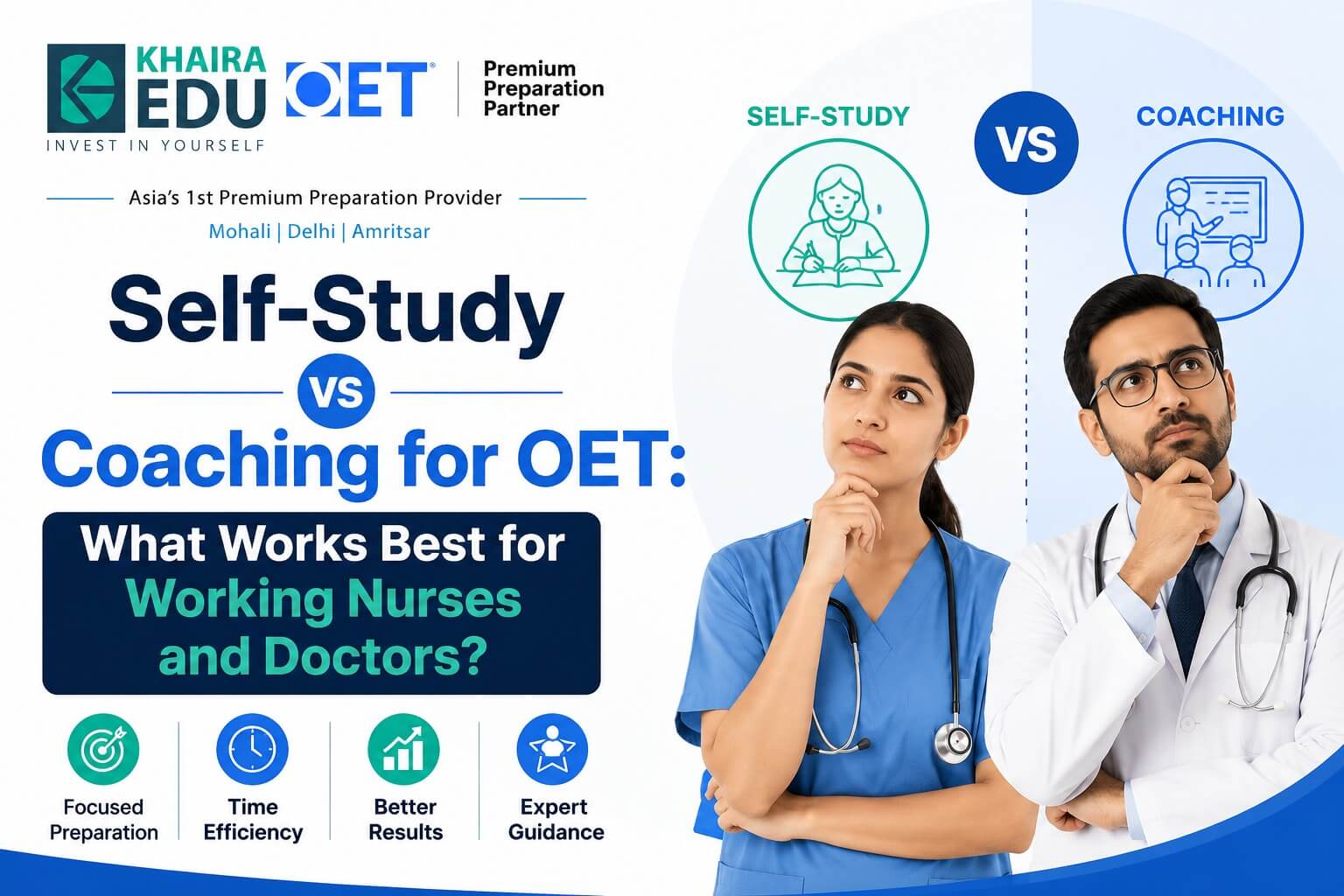
Self – study and coaching can both lead to strong OET scores for working nurses and doctors, but they suit different personalities, schedules, and starting levels. The best choice is the one you can follow consistently while working, not the one that looks ideal on paper.

Q1. What do working nurses and doctors really need from OET preparation?

Working healthcare professionals usually need three things from their OET prep: flexibility, focus, and feedback. Flexibility matters because duty rosters, night shifts, and emergencies make it hard to attend long, fixed – time classes every day. Focus is essential because you don’t have hours to waste on general English; you need OET – specific tasks that reflect real clinical communication.

Feedback is crucial because you can’t easily judge your own Writing and Speaking level, especially against OET criteria. Any preparation method-self – study or coaching-must respect these realities. If a plan looks good but doesn’t fit your actual week, you won’t stick to it. The right approach makes it easier, not harder, to study around your clinical responsibilities.

Q2. When does self – study work well for OET?

Self – study works best for candidates who are disciplined, comfortable planning their own work, and already have a reasonable level of English. If you can organise your time, follow a schedule, and honestly evaluate your performance, you can make strong progress using good materials and timed practice at home. Self – study also gives you maximum flexibility: you choose when, where, and how long to study, which is ideal if your shifts change frequently.

For many nurses and doctors, self – study is especially effective for Listening and Reading, where you can use sample tests, score yourself, and see improvement directly. You can also learn Writing structure and Speaking phrases from guides and videos, then practise them on your own. However, the success of self – study depends on how honest you are with yourself: if you often postpone study or stop when things feel difficult, you may struggle to reach your target without extra support.

Q3. What are the limitations of self – study?

The biggest limitation of self – study is the lack of expert feedback, especially for Writing and Speaking. You may practise letters and role – plays for weeks but repeat the same mistakes in structure, tone, or clarity without realising it. Many self – study candidates feel “stuck” at a certain level because they don’t know precisely what the examiners want or why their work is not reaching that standard.

Self – study can also feel lonely and confusing. With so many resources available, it’s easy to jump from one book or video to another without a clear plan, which leads to information overload rather than progress. After a full shift in the hospital, it can be harder to sit down and study if no one is expecting you to show up. For some people, this lack of external structure makes consistency very difficult.

Q4. How can coaching help working professionals prepare for OET?

Coaching provides structure, expert guidance, and regular feedback, which can be very valuable if you are unsure where to start or why your scores are low. A good OET course gives you a clear path: lessons on each sub – test, practice tasks, mock tests, and corrections that show you exactly what to improve. This saves time because you don’t have to design your own system from scratch.

For working nurses and doctors, coaching can also offer accountability. Knowing that you have a class, a task deadline, or a speaking session with a trainer can motivate you to study even when you’re tired. Many coaching programmes now offer flexible or online options, which means you can join classes outside your duty hours and revisit recordings if you miss a session. This blend of structure and flexibility often suits busy professionals who want support but cannot attend traditional classroom courses every day.

Q5. What are the drawbacks of coaching?

Coaching is not automatically better for everyone. It costs money, and the quality varies between providers. If a course is too crowded, offers very general English instead of OET – specific work, or gives minimal personal feedback, you may not see much more benefit than you would with well – planned self – study.

Fixed schedules can also clash with shifts, making you miss important lessons or feel constantly behind. Some candidates also become over – dependent on coaches, expecting the teacher to “pull” them through the exam. In reality, even with the best coaching, you still need to do independent practice, revise feedback, and manage your own time. Coaching is a tool, not a guarantee-its value depends on how actively you use it.

Q6. How can you decide what works best for you?

To choose between self – study and coaching, start by assessing your habits and needs honestly. If you are organised, motivated, and able to analyse your own performance, and if your budget is limited, self – study with occasional feedback can work very well. You might rely on official – style materials, set a strict weekly timetable, and ask a colleague or friend with strong English to review your letters or practise speaking with you.

If you feel lost, have already tried self – study without much improvement, or don’t understand why your Writing or Speaking scores are low, coaching is often a better option. In that case, look for a course that is clearly OET – focused, offers individual feedback, and has timings that fit your shifts. You can also combine both approaches: follow a coaching course for structure and corrections, while doing extra self – study practice on days when you don’t have class.

Q7. Is a mixed approach the most realistic for many working nurses and doctors?

For many working professionals, a blended approach-some coaching plus smart self – study-is the most practical and powerful. Coaching can give you a clear foundation: understanding the test, learning letter structures, practising role – plays, and receiving feedback on your strengths and weaknesses. Self – study then allows you to deepen and repeat what you’ve learned, using hospital experience and short daily practice to keep all four skills active.

You might, for example, attend a course twice a week and use your off days or lighter shifts for timed Reading and Listening sets, extra Writing practice, and speaking rehearsals. Over time, the combination of expert guidance and independent effort becomes a sustainable system. In the end, the “best” method is not simply self – study or coaching; it is the one that fits your schedule, matches your learning style, and keeps you moving steadily towards the OET scores you need for your next career step.

May 23, 2026

OET Speaking can feel especially intimidating for non-native speakers, but using the right phrases can help you sound natural, confident, and professional even if your grammar and accent are not perfect. The focus in the test is on clear communication, empathy, and good structure, rather than on using complicated English.

Q1. How should you start the conversation?

First impressions matter because a calm, friendly opening immediately builds trust and makes the patient feel safe. A simple structure works well: greet the patient, introduce yourself and your role, and show interest in their condition. For example, you might say, “Hello, my name is Maria. I’m one of the nurses here. I’ll be looking after you today. How are you feeling?” This kind of opening sounds natural, professional, and patient-centred.

Q2. How do you find out the patient’s main concern?

Before you can advise or explain anything, you must understand why the patient is there and what matters most to them. Open questions help the patient speak freely and give you more information. You can ask, “Could you tell me a bit more about what’s been happening?” or “When did these symptoms start?” If pain is involved, “Can you describe the pain for me?” sounds much more professional than simple yes/no questions. You can also ask, “Is there anything in particular you’re worried about?” to discover hidden concerns that you should address in the role-play.

Q3. How can you show empathy and understanding?

Empathy is a key part of OET Speaking because it shows you understand the patient’s feelings, not just their symptoms. Non-native speakers sometimes stay too formal, but even simple sentences can sound very caring. When a patient describes pain, fear, or stress, you can respond with phrases like, “I’m sorry to hear that you’re going through this,” or “I can understand that this is worrying for you.” Sentences such as, “It sounds like this has been very difficult,” or “Thank you for sharing that with me,” also work well. Using one of these empathetic responses at the right moment helps you sound natural and supportive.

Q4. How do you explain medical information in simple language?

OET rewards clear, patient-friendly explanations more than complex technical vocabulary. As a non-native speaker, it helps to follow a predictable pattern: say the medical term, then immediately explain it in everyday language. You might say, “You have a condition called hypertension.

This means your blood pressure is higher than normal. In simple terms, your heart is working harder than it should.” Short sentences, familiar words, and a step-by-step structure make you sound both professional and easy to understand. Phrases such as “Let me explain what will happen step by step” or “First, we will…, then we will…, and after that…” guide the patient smoothly through information about tests or treatments.

Q5. How can you give instructions and advice clearly?

When you give instructions or advice, you need to be polite but direct so the patient knows exactly what to do. You can start with phrases like, “I would recommend that you…,” “It’s important that you…,” or “Please try to….” For example, “I would recommend that you avoid very salty food and try to walk at least 30 minutes a day” sounds clear and professional. With medication, a natural pattern might be, “You need to take this tablet twice a day, once in the morning and once in the evening. Please take it after food to avoid stomach upset.” Using time markers and reasons like this helps the patient remember and follow your advice.

Q6. How do you check understanding without sounding rude?

Checking understanding is essential in OET, but it must be done gently so the patient does not feel tested. Instead of asking, “Do you understand?” which often leads to a quick “yes,” try softer, more open phrases. You can say, “Does that make sense so far?” or “Is everything clear up to this point?” Another useful sentence is, “Do you have any questions about what I’ve just explained?” If you want to be sure the patient can follow instructions, you might say, “Could you tell me in your own words how you will take this medicine?” This sounds respectful and allows you to correct any misunderstandings early.

Q7. How can you handle patient worries and questions?

Patients in OET role-plays are often anxious, confused, or sceptical, so you need language that both acknowledges their feelings and offers realistic reassurance. A good pattern is to first show understanding, then provide information.

You might say, “I understand that you’re worried about this,” followed by, “This test is very common and generally safe, and we will monitor you closely throughout.” Another helpful sentence is, “Many people feel the same way before this procedure,” which normalises their fear. Finish with a clear, supportive message, such as, “If you notice anything unusual or if your symptoms get worse, please contact us straight away.”

Q8. How should you politely correct or guide a patient?

Sometimes the patient has inaccurate beliefs, and you must correct them without sounding dismissive. A polite way to do this is to acknowledge their point of view, then introduce the correct information. For example, you can say, “I can see why you might think that, but actually this is a viral infection, so antibiotics won’t help.” Another option is, “There’s a common misunderstanding about this. Let me explain,” which sounds respectful and educational. If you need to be more direct, “I’m afraid that isn’t quite correct. The situation is…” followed by a simple explanation keeps the tone professional.

Q9. How do you close the conversation professionally?

A strong closing shows examiners that you can summarise, confirm understanding, and explain next steps clearly. A simple structure works best: summarise key points, check for final questions, and give safety or follow-up advice.

You might say, “Let me just summarise what we’ve discussed. You’ll start the new medication tonight, take it once a day, and come back in two weeks for a review.” Then you can add, “Do you have any other questions or concerns before we finish?” and finish with, “If you notice any changes or if you’re worried, please contact us straight away. Thank you for coming in today.” This kind of closing sounds organised, caring, and complete.

Q10. How can non-native speakers practise these phrases so they sound natural?

To sound natural, you must use these phrases regularly, not only read them once. Choose a small set of expressions for openings, empathy, explanations, advice, checking understanding, and closing, then practise them aloud every day. Recording yourself on your phone and listening back helps you hear whether you speak too fast, too softly, or in very flat tone.

Aim for a calm, steady pace rather than trying to sound like a native speaker. You can also create short role-plays for common situations such as chest pain, diabetes education, or anxiety before surgery, and talk through them using these phrases. With repetition, the language becomes automatic, so in the real OET exam you can focus on the patient’s needs instead of searching for words, which is exactly what makes you sound both natural and professional as a non-native speaker.

May 23, 2026

OET can be a powerful bridge for return-to-practice nurses who want to restart their careers in an English-speaking healthcare system after a break. It helps you prove your communication skills, rebuild confidence, and meet regulatory requirements at the same time.

Q1. Why do return-to-practice nurses need OET?

If you have taken a career break-for family, health, relocation, or study-regulators and employers still need up-to-date proof that you can communicate safely in English. OET, being healthcare-specific, shows that you are ready to handle real clinical communication again: taking histories, explaining care, and documenting accurately. After a gap, this kind of formal evidence reassures both you and the system that you can re-enter practice safely.

For many countries, OET is also linked to return-to-practice or re-registration pathways. Even if you have strong clinical experience from the past, you may not meet current language policy without a recognised test. Achieving the required OET scores can therefore unlock bridging programmes, supervised practice roles, or direct registration routes that would otherwise stay closed.

Q2. What unique challenges do return-to-practice nurses face?

Nurses coming back after a break often carry two sets of worries: clinical and linguistic. You may feel out of touch with new guidelines, technology, and terminology, and at the same time anxious about your English fluency, especially if you haven’t used it regularly. It is common to worry that you are “too rusty” or “too old” to sit a high-stakes exam again.

There are also emotional challenges. You might feel embarrassed about the gap in your CV or nervous about studying alongside younger, currently practising colleagues. Balancing family responsibilities and exam preparation can feel harder than it did earlier in your career. Recognising these challenges is important, because it allows you to design a realistic, compassionate plan instead of comparing yourself unfairly with others.

Q3. How can you restart gently with OET after a long break?

The best way to restart is gently but deliberately. Begin by familiarising yourself with the current OET format for nursing: what happens in Listening, Reading, Writing, and Speaking, and what kinds of tasks you will face. This first step alone reduces anxiety because it turns an unknown exam into something concrete and manageable. Next, do a low-pressure self-check.

Try a short sample task in each skill-not to judge yourself harshly, but to see where you stand now. You might find that your reading and listening are better than expected, while writing and speaking feel slower. Treat this as information, not a verdict. It gives you a clear starting point for your preparation plan.

Q4. How can you use past nursing experience as an advantage?

Your previous nursing experience is a major strength, even if it feels distant. You already understand how real consultations, handovers, and care plans work, which gives you a big advantage in OET tasks that mirror these situations. You know what matters in a referral letter, how to reassure an anxious patient, and what information colleagues need for safe continuity of care.

To use this advantage, consciously connect OET tasks to situations you handled in the past. When you write a referral letter, think of how you used to hand over to another ward or specialist. When you do a speaking role-play, remember similar conversations you had with real patients. This makes the exam feel less like a school test and more like a structured version of work you already know.

Q5. How should return-to-practice nurses plan their study time?

After a break, your life may be centred around home responsibilities rather than shifts, but time is still limited. Aim for short, regular study blocks-perhaps 45-60 minutes a day, four to six days a week-rather than long, exhausting sessions. Consistency helps your language skills “wake up” steadily without overwhelming you.

Start with easier, confidence-building tasks, then gradually increase difficulty. For example, you might begin with shorter reading texts and listening clips, then move to full sub-tests under time conditions. Build a weekly pattern such as: two days focusing on Listening and Reading, two days on Writing, one or two days on Speaking, with one lighter review day. This gentle structure supports steady progress.

Q6. How can you rebuild writing skills for OET Nursing?

Writing can feel particularly challenging after a break, especially if you haven’t written formal English in years. Focus first on understanding the typical structure of OET Nursing letters: stating the purpose, summarising relevant history, describing the current situation, and making clear requests or recommendations to the reader. Practise by turning short case notes into full letters.

At first, don’t worry about perfection; concentrate on selecting only relevant details and grouping them into clear paragraphs. As you gain confidence, refine your tone, grammar, and linking phrases. Comparing your letters with model answers (without copying them) helps you see how experienced writers organise information, which you can then adapt to your own style.

Q7. How can you regain speaking confidence for OET?

Speaking after a long break is often more about confidence than pure language. Begin by speaking English aloud every day, even if it’s just talking through your routine tasks or explaining a simple health topic to yourself. This helps your mouth and mind reconnect with the language without pressure.

Then move to nursing-specific role-plays. Use a simple, repeatable structure: greet and introduce yourself, explore the patient’s concerns, explain the situation in simple terms, give advice, check understanding, and close politely. Practise with a friend, family member, or another nurse if possible, or record yourself and listen back. You will notice that, with repetition, you sound more organised and calm, even if your vocabulary is not perfect.

Q8. Should return-to-practice nurses choose self-study, coaching, or a mix?

Your choice depends on how confident and independent you feel as a learner. If you enjoy planning your own work and feel comfortable with technology, you can start with self-study using high-quality OET materials, then add occasional tutoring or feedback sessions for Writing and Speaking. This gives you flexibility around family life and other commitments.

If you feel lost, very out of practice, or overwhelmed by starting alone, a structured course may be more helpful. Coaching can provide a clear roadmap, regular tasks, and personal feedback, which are especially valuable if you have been away from exams for many years. Many return-to-practice nurses do best with a blended approach: a course for structure plus self-study for extra practice and consolidation.

Q9. How can OET support your confidence beyond the exam itself?

Preparing for and passing OET does more than prove your English level; it often transforms how you see yourself as a professional. As you rebuild your ability to write, speak, listen, and read in clinical English, you often rediscover your identity as a nurse, not just as someone who took a long break. This renewed confidence makes the next steps-bridging programmes, job interviews, orientation programmes-feel more achievable.

You can introduce yourself to colleagues, participate in discussions, and advocate for patients without constantly worrying about your language. In this way, OET becomes both a formal requirement and a personal milestone in your return-to-practice journey. For return-to-practice nurses, OET is not just an exam; it is a structured pathway back into the profession you chose, helping you reconnect your past experience with your future in international healthcare.

May 23, 2026

A smart last-week OET revision plan is about polishing what you already know, not trying to transform your English in seven days. Your aim is to walk into the exam familiar with the format, steady with timing, and mentally calm.

Q1. What is the main goal of the last week?

In the final week before OET, the goal shifts from “learning more” to “performing better.” This means consolidating your existing skills, tightening your strategies, and rehearsing exam conditions so that nothing feels new on test day. You are not trying to become fluent in a week; you are training yourself to use the level you already have in the most effective way. Thinking of this week as performance practice rather than emergency study instantly reduces unrealistic expectations. It encourages you to focus on clarity, timing, and confidence instead of chasing big improvements in vocabulary or grammar that simply cannot happen overnight.

Q2. What should you do for Listening in the last week?

For Listening, focus on maintaining sharpness and staying comfortable with the format and timing. Do several full Listening practices under exam conditions, treating them like mini-exams. Before each recording starts, read the questions quickly and underline or mentally note key words so you know what to listen for.

After each practice, review your mistakes with a calm, analytical mind. Ask yourself whether you missed answers because of accents, numbers, key details, or simple loss of concentration. Use short, targeted listening clips to work on those specific problems rather than doing endless full tests. In the final week, quality practice is more valuable than exhausting yourself with too many long sessions.

Q3. How should you revise Reading in the final days?

In Reading, the last week is about speed, strategy, and confidence. Continue practising full Reading parts with a timer so you stay tuned to the pace of the exam.

Practise skimming to get the main idea of a text quickly and scanning to find specific information like names, numbers, and keywords, instead of reading everything slowly and carefully. When checking your answers, pay special attention to question types that still cause difficulty, such as inference questions or matching tasks. Spend short sessions focusing just on those patterns so your brain learns how they “work.” Avoid trying to cram lots of new vocabulary at this stage; it is more effective to sharpen how you use the vocabulary and strategies you already know.

Q4. How can you polish Writing in the last week?

For Writing, the final week should centre on structure, relevance, and clarity rather than completely changing your style. Practise writing letters from case notes and aim for a clear pattern: purpose in the opening sentence, relevant background, current situation, important clinical details, and specific requests or recommendations for the reader.

Create a personal checklist based on your past feedback or self-review. It might include items like “Is my purpose sentence clear?”, “Have I included only relevant information?”, and “Is my tone formal and professional?” After you write each practice letter, quickly check it against this list. This routine helps you avoid repeated mistakes and makes your writing more consistent in the exam.

Q5. How should you prepare for Speaking in the last week?

Speaking revision in the last week is about making your conversation structure automatic and your phrases comfortable. Practise role-plays with a simple, repeatable pattern: greet and introduce yourself, explore the patient’s problem and concerns, explain the situation or condition in plain language, give advice or options, check understanding, and close politely. Record yourself in a few practice role-plays and listen back.

Notice whether you speak too fast, whether your explanations are clear, and whether you sound empathetic or mechanical. Adjust gently: slow down a little, add natural empathetic phrases, and use language you already control rather than trying to introduce lots of new expressions at the last minute. The aim is to sound calm, organised, and caring, not perfect.

Q6. What should your daily routine look like in the last week?

A balanced daily routine for the last week could include one main practice block and one lighter review block. For example, you might do a full Reading or Listening part in the morning or afternoon under timed conditions, then spend 30-40 minutes later on Writing or Speaking practice. Keep each session focused and give yourself breaks between them so your concentration stays high.

Plan at least one day as an “exam rehearsal”: complete all four sub-tests in order, with realistic timing and only short breaks, to mimic the real experience. Afterwards, note how your energy and focus felt through the day and adjust your expectations and strategies accordingly. Then give yourself proper rest rather than jumping straight into more heavy study.

Q7. What should you avoid doing in the last week?

There are several common traps to avoid. The first is trying to completely change your preparation strategy or materials at the last minute. Switching to a totally new book, method, or pattern of writing can create confusion and reduce your confidence. Stick mainly to what you’ve been doing and make small, targeted improvements.

You should also avoid extreme cramming and very late-night study sessions, especially the night before the exam. Lack of sleep harms concentration, memory, and emotional control more than a few extra hours of revision can help. Finally, try not to obsessively compare your preparation with other candidates online. Everyone’s journey is different, and anxiety from comparison rarely improves performance.

Q8. How can you look after your body and mind before the exam?

In the last week, caring for your physical and mental state is as important as practising tasks. Aim for a regular sleep pattern as much as your work allows, and favour simple, nourishing food over heavy or irregular meals. Light exercise, stretching, or short walks can help release tension and clear your mind.

Practise a simple calming technique you can use on exam day, such as slow breathing: inhale slowly, exhale more slowly, and repeat for a few cycles when you feel nervous. Remind yourself that feeling a little anxious is normal and does not mean you will fail. You are not trying to remove all nerves, only to keep them small enough that you can still think clearly and use the skills you have built.

Q9. What should you do the day before and on the day of the exam?

The day before the exam, keep your work light and focused on review rather than heavy practice. Go through your key notes: Writing structures, Speaking phrases, common Reading and Listening strategies, and your personal checklists. Prepare everything you need-documents, route to the centre, snacks, and clothes-so you are not stressed by practical issues. On exam day, follow a simple, calm routine.

Eat a light meal, arrive early, and use your breathing or grounding techniques while you wait. During each sub-test, stay in the present: concentrate only on the part you are doing, instead of worrying about what has already happened or what comes next. Trust that your preparation and last-week revision have prepared you to do your best. A thoughtful last-week OET revision plan-built on consolidation, realistic practice, and self-care-helps you walk into the exam feeling prepared rather than panicked. You are not trying to become a different candidate in seven days; you are helping your real ability to show clearly on test day.

May 23, 2026

How to Build Medical Vocabulary for OET Without Memorising Word Lists

Building strong medical vocabulary for OET does not require boring word lists; it works best when you learn words in context, through real situations, and use them actively. The goal is to understand and explain medical terms clearly, not just recognise them on paper.

Q1. Why should you avoid pure word memorisation?

Memorising long lists of medical words often feels productive, but most of those terms never appear in your real OET tasks or daily practice. You may remember them for a few days, then forget them because they are not connected to any meaningful context. This “cramming” also rarely helps you explain things in simple language to patients.

OET tests your ability to use vocabulary in real communication-letters, role – plays, consultations, and information texts. That means you need to know not only the technical term, but also how to use it in a sentence, explain it in everyday words, and combine it with other expressions. Learning vocabulary through realistic situations prepares you for this much better than isolated word lists.

Q2. How can you learn vocabulary from real cases?

One of the best ways to build medical vocabulary for OET is to use your own clinical experience. After a shift or a day of study, choose one case or topic-for example, chest pain, asthma, diabetes, wound care, or depression. Think about the words and phrases you used or heard: symptoms, tests, treatments, and advice.

Write down a short, simple summary of the case in your own words, as if you are explaining it to a new colleague or a patient. As you do this, you will naturally collect useful vocabulary in context. You can then highlight key phrases, such as “shortness of breath,” “we will monitor your blood pressure,” or “you may feel some discomfort after the procedure,” and practise reusing them in other similar cases. This connects vocabulary directly to situations you understand and remember.

Q3. How can you use “pairs” of technical and simple terms?

OET expects you to understand technical words but often speak and write in patient – friendly language. A powerful method is to learn vocabulary in pairs: one medical term and one simple explanation.

For example, “hypertension – high blood pressure,” “myocardial infarction – heart attack,” or “dyspnoea – difficulty in breathing.” When you read or hear a medical term, immediately practise saying how you would explain it to a patient who has no medical background. Over time, you build a mental “dictionary” where each technical word is linked to a clear, everyday phrase. This helps you in Speaking and Writing, where you might need to mention the diagnosis for colleagues but also show the examiner you can communicate clearly with patients.

Q4. How does reading help you grow vocabulary naturally?

Reading is one of the most efficient ways to build vocabulary without memorising lists. Choose short, accessible healthcare texts such as patient information leaflets, health – education articles, or summaries of common conditions. As you read, notice which words and phrases appear repeatedly in similar contexts.

Instead of stopping for every new word, focus on expressions that seem particularly useful for OET tasks: ways of describing symptoms, giving instructions, explaining risks and benefits, and advising on lifestyle changes. Underline or note these phrases, then try to reuse them by writing a short paragraph or letter about a similar topic. Learning vocabulary through repeated exposure in meaningful texts helps you remember it more easily and use it more naturally.

Q5. How can listening activities build your vocabulary?

Listening to healthcare-related conversations or explanations can also boost vocabulary, especially for Speaking. When you hear doctors, nurses, or educators explaining conditions and treatments in clear language, you learn ready – made phrases and sentence patterns that you can adapt in your own OET responses.

You can practise by listening to health talks, patient education videos, or medical podcasts aimed at the general public. When you hear a useful expression, pause and repeat it aloud, then try using it with a different condition. For example, if you hear “This test will help us understand how well your heart is working,” you can adapt it to “This scan will help us see how well your lungs are working.” This active reuse turns passive vocabulary into something you can confidently produce in the exam.

Q6. How can you use speaking and writing to “lock in” new words?

Vocabulary becomes truly yours when you use it, not just when you recognise it. Whenever you learn a new word or phrase, try to use it in both speaking and writing within the next day. For speaking, you can create a quick role – play: imagine a patient asking about their condition and respond using the new expression.

For writing, add the phrase to a short practice letter or a case summary. This repeated, active use helps your brain store the vocabulary more deeply. It also lets you notice whether you are using the word correctly, so you can adjust early if needed. Over time, you will find that certain phrases start coming to you automatically when you write or speak, which is exactly what you want in OET.

Q7. How can you organise vocabulary without lists?

Instead of one long list, organise your vocabulary by topic and function. Topic-based groups might include cardiology, respiratory, diabetes, mental health, maternity, or post – operative care. Function-based groups might focus on phrases for explaining procedures, giving advice, describing symptoms, or reassuring patients.

In a notebook or digital document, keep short sections for each topic and add new words and phrases as you meet them in context. Under each phrase, write one or two example sentences related to real or imagined patients. This simple organisation system makes it easy to revise before practice sessions or exams and reminds you of how the vocabulary is used in real communication, not just as isolated words.

Q8. How should you review vocabulary so you don’t forget it?

Regular, spaced review is more effective than trying to remember everything at once. Instead of revising all your notes in a single long session, spend a few minutes each day or several times a week revisiting older topics.

Read your example sentences aloud, cover them and try to say them from memory, or quickly explain a condition using as many of the phrases as you can remember. You can also test yourself by turning key words into questions, such as “How would I explain this term to a patient?” or “How could I use this phrase in a referral letter?” This kind of active recall strengthens your memory and prepares you for the kind of thinking you will do in the exam. Over time, you will notice that your vocabulary grows naturally and becomes part of your normal way of communicating, both in OET and in your real healthcare practice.

May 23, 2026

OET scores can do much more than simply tick an English – language requirement box; they can open doors to new countries, better roles, and long – term career growth for nurses. While I do not have live access to external verification tools right now, the points below reflect how OET is widely used in international nursing pathways.

Q1. How do OET scores unlock international registration?

For many English – speaking countries, a qualifying OET score is one of the standard requirements for overseas nurse registration. Nursing councils and regulatory bodies use OET because it focuses on clinical communication-reading charts, writing referral – style letters, and speaking with patients and families. Meeting the required bands shows regulators that you can operate safely in an English – speaking healthcare environment.

Once you have the accepted OET scores, other parts of the registration process, such as document verification and professional exams, can move forward. Without those scores, your application may not even be considered. In this sense, OET is a gateway: it changes your status from “interested applicant” to “eligible candidate” in the eyes of overseas regulators.

Q2. How can OET scores improve your job opportunities and salary?

Strong OET scores signal to employers that you are ready to communicate confidently with patients, families, and multidisciplinary teams from day one. Hospitals and recruitment agencies know that nurses with good OET results are less likely to struggle with handovers, documentation, or patient education. This makes you a more attractive candidate in competitive international markets.

Better communication also tends to be linked to better performance reviews, smoother probation periods, and quicker integration into teams. Over time, this can influence the kinds of wards or specialties you can join, your chances of moving into supervisory roles, and your overall earning potential. In short, OET scores don’t just get you into the system; they can help you progress within it.

Q3. How do OET scores help you specialise and advance?

As your career develops abroad, you may want to move into specialised areas such as ICU, oncology, theatre, community nursing, or advanced practice roles. These paths usually demand clear communication in complex situations: discussing risks, explaining procedures, coordinating with doctors and allied health professionals, and documenting detailed care plans. The preparation you do for OET-especially in Writing and Speaking-builds exactly these skills.

Learning how to write concise, focused letters teaches you to summarise cases for specialists. Practising role – plays makes it easier to handle sensitive conversations about diagnosis, prognosis, or lifestyle change. In many settings, this level of communication is a key factor in selecting nurses for specialist posts or leadership tracks.

Q4. How can OET preparation boost everyday clinical confidence?

Even before you move countries, preparing for OET can transform how you feel and perform at work. As you practise explaining conditions in simple English, checking understanding, and responding empathetically, you become more confident handling English – speaking patients in your current hospital. This confidence reduces stress, especially in high – pressure areas like emergency and critical care.

Stronger language skills also help you participate more actively in ward rounds, handovers, and multidisciplinary meetings. You may find it easier to ask questions, clarify orders, and advocate for your patients. This professional presence is noticed by colleagues and managers and can change how you are perceived, even before your international move happens.

Q5. How do OET scores support long – term mobility and security?

Once you have a valid OET result that meets or exceeds common regulatory requirements, you gain more flexibility in planning your future. If circumstances change and you decide to move to a different English – speaking country, your OET score may still be accepted there, subject to each regulator’s rules and validity periods.

This gives you options rather than tying your entire plan to a single destination. In the long term, having demonstrated English proficiency through a healthcare – specific exam can also support applications for promotions, internal transfers, or further education such as postgraduate nursing programmes. It provides formal evidence that your communication skills meet an international standard, which is reassuring for universities and employers alike.

Q6. How can you use OET scores strategically in your career planning?

To get the most from OET, treat your target scores as part of a bigger career roadmap rather than just an exam goal. Before you book the test, research the requirements for the countries and nursing councils you’re interested in, and set your score targets accordingly. Aim not just to “scrape through,” but to reach a level that gives you confidence and some margin above the minimum. After you achieve your scores, include them clearly on your CV and in job applications, highlighting any strong sub – test results that show particular strengths in communication.

Continue using the skills you developed-structured writing, patient – friendly explanations, active listening-in your daily practice. In this way, your OET result becomes both a key that opens international doors and a foundation you build on throughout your nursing career. Ultimately, OET scores can transform your international nursing journey by turning ambition into eligibility, eligibility into opportunities, and opportunities into long – term growth and mobility. When you see the exam as an investment in your professional identity-not just a hurdle to pass-it becomes a powerful tool for shaping the future of your career.

May 23, 2026

Balancing family, finances, and OET preparation is one of the hardest parts of the migration journey for nurses, but with a realistic plan and clear priorities, it becomes manageable instead of overwhelming. Think of it as designing a “whole-life” study strategy, not just an exam timetable.

Q1. Why is OET so challenging for migrant nurses with families?

For many migrant nurses, OET is not just an exam; it is tied to visas, job offers, children’s education, and long-term financial security. That makes the emotional pressure very high. At the same time, you may be working long shifts, sending money home, and managing responsibilities as a parent, partner, or caregiver.

Time, energy, and money are all limited, and OET preparation competes with urgent daily needs. This combination means you cannot afford a “perfect student” routine. You need something flexible and forgiving that accepts real-life interruptions. Recognising that your situation is genuinely demanding is important, because it stops you from comparing yourself unfairly to candidates who study full-time or have fewer responsibilities.

Q2. How can you plan OET around family responsibilities?

The first step is to make your family part of your OET plan instead of treating them as an obstacle to it. Talk openly with your partner, children (if they are old enough), or other relatives about why you are preparing for OET and how it will benefit everyone in the long run. When your family understands that your study time is an investment in their future, they are more likely to support and protect that time.

Next, look at your weekly routine and identify small, regular blocks where you can study with minimal interruption. For many nurses, this might be early mornings before others wake up, or one quiet hour in the evening. Aim for focused 30-60 minute sessions rather than long marathons. Plan lighter tasks on days when family duties are heavy, such as vocabulary review or listening practice, and save more demanding tasks-like full Writing or Reading sets-for quieter days or when someone can help with childcare.

Q3. How can you manage OET costs without harming your finances?

OET is expensive, especially when you include exam fees, materials, and possible coaching. The key is to treat it like any other major financial commitment: plan, budget, and avoid unnecessary repeats. Start by listing expected costs: exam fee, a realistic amount for preparation (books, online resources, or a course), and any travel expenses for the test centre.

Then decide what you can afford each month without putting essential bills or family needs at risk. You might choose to delay your exam date slightly so you can save gradually, rather than rushing into a sitting you are not ready for. Use high-quality free or low-cost resources where possible, and spend money strategically on things that give the biggest return-such as targeted feedback on Writing and Speaking if these are your weak areas. This careful approach reduces the chance of paying for multiple unsuccessful attempts.

Q4. How do you cope with guilt about time away from family?

Many migrant nurses feel guilty when they study because they think they are taking time away from children or partners. It helps to reframe this mentally. Instead of seeing study time as “stealing” from your family, see it as “building” for your family. You are working towards better income, stability, and opportunities for them.

Sharing this perspective with your loved ones can ease the emotional pressure. You can also create small rituals that keep connection strong even when you are busy. For example, you might dedicate a short, device-free time every day to talk or play with your children, or keep one evening a week for family activities. When your family sees that you still care about them and that OET is a temporary, purposeful project, the guilt reduces and their support increases.

Q5. How can you protect your physical and mental health?

Balancing work, family, and OET is physically and emotionally demanding. Without basic self-care, you risk burnout, which hurts both exam performance and family life. Try to maintain regular sleep as much as your shifts allow, even if it means studying slightly less. A tired mind learns slowly and forgets quickly, so four focused hours a week are often better than ten exhausted ones.

Include simple stress-management habits in your routine. Even a few minutes of deep breathing, stretching, or a short walk can help reset your mind. Watch for warning signs like constant irritability, frequent illness, or feeling hopeless about OET. If these appear, it may be better to reduce your study load briefly or push your exam date back, instead of pushing yourself to breaking point.

Q6. What kind of study routine works when you are working and supporting a family?

A practical routine for many migrant nurses is a “little and often” model. For example, you might do 30 minutes of Listening or Reading on workdays and 60-90 minutes of Writing or Speaking practice on days off. Use travel time or small gaps during the day for lighter tasks, like revising phrases, reading health articles, or listening to short audios.

Link your study plan to your work and home life. If you had a clinically heavy day, choose lighter OET work that evening. If your shift was easier or you had a day off, you can attempt a full mock test or more intensive practice. Keep your weekly goals clear but modest-such as “two Writing tasks, two Speaking sessions, and three short Listening/Reading practices”-so you feel progress without constant pressure.

Q7. How can you involve your support network?

You do not have to do this alone. If possible, ask your partner, relatives, or close friends to help with specific tasks that free up study time, such as watching the children for an hour, helping with household chores on mock-test days, or giving you a quiet space. Even small acts of support can make a big difference.

You can also look for study partners who understand your situation-other migrant nurses balancing similar responsibilities. Studying together online or in person once a week can keep you motivated and accountable. Sharing challenges and small victories with people who “get it” reduces the feeling of isolation and helps you stay on track.

Q8. How do you decide when you are ready to book the exam?

When money and family hopes are involved, you need to be strategic about your exam date. Instead of booking based on emotion (“I’m tired of waiting; I’ll just try”), use evidence from your practice. You might decide you are ready when you consistently reach your target scores in mock tests, especially in Writing and Speaking, which are harder to judge. Be honest with yourself: if your practice scores are still far below your goal, booking immediately may add more financial and emotional stress.

On the other hand, do not wait for absolute perfection. There will always be some nerves and some mistakes. Aim for a realistic balance: a strong, consistent practice level that shows you are likely to pass, combined with a clear plan for the remaining weak areas. Balancing family, finances, and OET is a long, demanding journey, but it is also a powerful investment in your future as a migrant nurse. By planning carefully, protecting your health, involving your support network, and taking steady, realistic steps, you can move towards your international goals without sacrificing the people and stability that matter most to you.

May 23, 2026

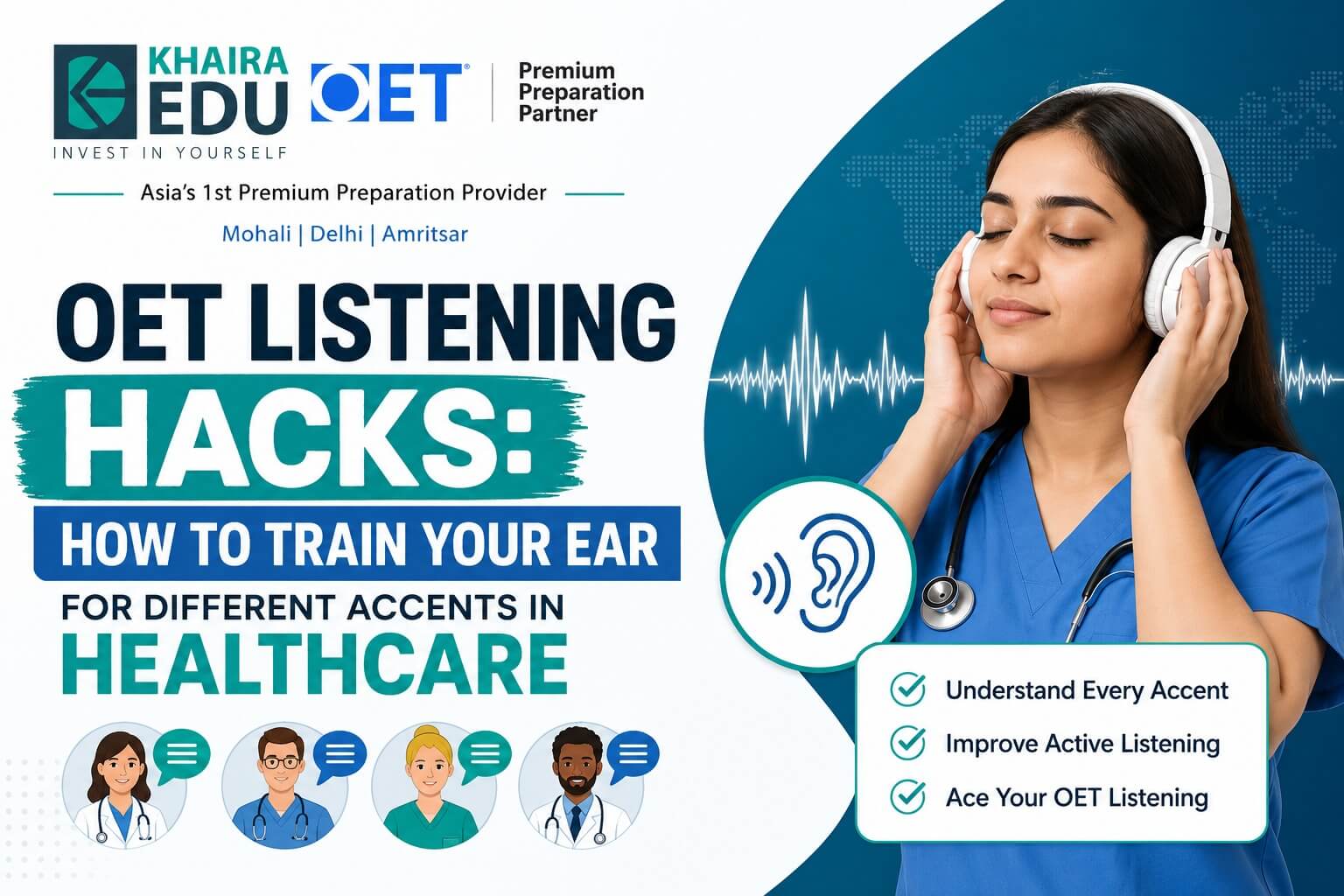
OET Listening becomes much easier when you deliberately train your ear to handle different accents, speeds, and speaking styles commonly heard in healthcare settings. Even without external tools right now, the strategies below follow the standard OET Listening format and widely accepted listening skills techniques.

Q1. Why do accents cause problems in OET Listening?

Many candidates can understand English well in the classroom or on TV but struggle when they hear unfamiliar accents, especially under exam pressure. In OET, you may hear a range of native and nonnative accents British, Australian, American, and others because the test reflects real international workplaces. If you only Practise with one type of English, your ear is not ready for this variety.

Accents affect sounds, rhythm, and even how words are linked together, so familiar vocabulary may suddenly seem “new.” When you are anxious, your brain also needs more time to adjust, which can make you miss whole phrases. Training your ear in advance reduces this shock and helps you focus on meaning instead of getting stuck on pronunciation.

Q2. How can you build a solid base for OET Listening?

Before focusing on accents, you need a basic habit of active listening to healthcare content. This means listening with a clear purpose, not just having audio in the background. When you listen, always ask yourself, “What is the main problem? What tests or treatments are mentioned? What advice is given?” This keeps your brain engaged and closer to the way OET questions work.

It also helps to get used to typical consultation structure: greeting, history, examination or tests, diagnosis, and plan. The more familiar you are with this pattern, the easier it becomes to predict what kind of information might come next, even if the accent is new. Prediction is one of the most powerful listening skills because it fills in small gaps when you miss a word or two.

Q3. How do you start training your ear for different accents?

The best way to get comfortable with accents is gradual, repeated exposure. Choose short healthcare related audios or videos in different English accents and listen to them regularly. At first, do not worry if you do not catch everything. Your goal is to let your ear “meet” the accent several times until it stops sounding strange.

Begin with shorter clips so you are not overwhelmed. Listen once to get the general idea, then listen again and focus on key words such as symptoms, time expressions, numbers, and treatment names. Over time, you can move to longer consultations and discussions. The more your ear recognizes the rhythm and sound patterns of an accent, the less energy you need to understand it in the exam.

Q4. What specific techniques help you cope with unfamiliar pronunciation?

When you meet a new accent, you may notice that some sounds are dropped, joined, or changed. Instead of panicking, focus on context and word shape. Ask yourself: is this likely to be a symptom, a test, a date, or a number? Even if you miss one word, the surrounding information usually tells you what kind of word it must be.

Shadowing is a useful technique here. Play a short sentence, pause, and immediately repeat it aloud, copying the speaker’s rhythm and intonation as closely as you can. You do not need to become an expert mimic; the goal is to train your mouth and ear together. This makes fast or connected speech easier to recognize later, and it also improves your own speaking naturalness.

Q5. How can you use healthcare content to train your ear daily?

Since you are preparing for OET, it makes sense to train your listening with medical or healthcare content, not random audio. Listen to patient stories, health education talks, or interviews with doctors and nurses. These often contain the same types of vocabulary and structures you will hear in OET Listening: explaining symptoms, discussing diagnoses, and giving lifestyle advice.

Try turning this into a routine. For example, listen to a short health related clip once or twice a day, perhaps on your commute or during a break. The first time, just follow the general message. The second time, focus on details such as what tests are ordered, what advice is given, or what follow-up is planned. You can even pause and summaries what you heard in one or two sentences, which strengthens both listening and speaking skills.

Q6. How should you Practise with OET-style questions?

To connect accent training directly to exam skills, you need regular practice with OET-style questions under time pressure. When you work with sample tasks, always read the questions first, underlining key words. This prepares your brain to listen for specific information instead of trying to understand every sound equally.

During the audio, concentrate on the part of the conversation linked to each question. If you miss one answer, do not let frustration distract you from the rest. Make a quick guess and move on mentally. After the practice, listen again without answering, just to understand the conversation more fully. Notice where you lost information: was it a fast pronunciation, an unfamiliar accent, or simply a moment of distraction? This reflection helps you target what to improve next time.

Q7. How do you train for numbers, names, and critical details?

Accents can make numbers, drug names, and dates harder to catch, but these details are often tested in OET. To train this skill, focus on short clips or recordings that include many numerical details. Listen specifically for times, dates, dosages, and measurements. Practise writing them down quickly and clearly, just as you will in the exam.

You can also pause after a key sentence and repeat the numbers aloud, which reinforces recognition. If a particular type of number (for example, “thirteen” versus “thirty”) confuses you, look for more listening practice where that contrast appears. Over time, your brain learns to expect certain patterns in healthcare contexts, such as common medication doses or appointment timings, which makes recognition easier even with accent variation.

Q8. How can you stay calm when the accent feels difficult during the exam?

Even with good preparation, you may meet an accent on test day that feels harder than expected. The most important thing is not to panic. Remind yourself that you do not need to understand every single word to answer the questions correctly. Focus on the task in front of you, use the written questions as a guide, and keep listening for key information rather than trying to translate every sound.

If your mind starts to race, use your breathing to steady yourself between parts of the test. A slow, deep breath can reset your focus. Tell yourself, “I don’t have to catch everything; I just need the important points.” This mindset keeps you flexible and allows your training to work, even when the accent is challenging.

Q9. How can you combine all these hacks into a simple routine?

A practical listening routine for OET could look like this: several times a week, do a short, timed OET-style listening task; then on other days, listen to one or two brief healthcare audios in different accents. After each practice, review where you had trouble, and spend a few minutes shadowing difficult sentences or repeating important phrases. Try to mix focused exam practice with more relaxed exposure to diverse accents so your ear stays active without becoming overloaded.

Over weeks and months, these small, regular steps train your ear to recognize meaning across different voices and styles. When you finally sit for OET, you will not be hearing those accents for the first time; they will already feel familiar, allowing you to concentrate on the questions and show the listening skills you have worked hard to build.


May 23, 2026

Top OET preparation mistakes often come from good intentions but poor strategy, especially when you’re juggling shifts, family, and high expectations. Understanding these traps and how to avoid them can save you time, money, and stress.

Why do so many healthcare professionals struggle with OET prep?

Many nurses and doctors assume that because they use English at work, they don’t need a targeted plan for OET. In reality, the exam tests specific skills like structured letter writing, timed reading, and profession‑focused role‑plays that even experienced professionals haven’t practiced for years. Without a clear strategy, they repeat the same routine, take the exam, and end up disappointed with their scores.

Another big reason is time pressure. Busy professionals often try to “fit OET in” around everything else instead of designing a realistic schedule. This leads to cramming, irregular practice, and a constant feeling of being behind. The result is not just lower performance, but also higher anxiety on test day, because you know deep down that your preparation wasn’t organized.

Mistake 1: Treating OET like a general English exam

One of the most common mistakes is preparing for OET in the same way you would prepare for a general English exam like IELTS or TOEFL. Candidates focus on essays, generic listening clips, and academic reading, but OET tasks are built around healthcare scenarios, patient communication, and professional letters. This mismatch means a lot of study time doesn’t translate into exam readiness.

To avoid this, make sure most of your practice materials are OET‑style or healthcare‑specific. Work with case notes, clinical texts, and role‑plays that mirror real consultations. When you read or listen to something, ask, “How similar is this to OET?” If the answer is “not very,” keep it as extra practice but don’t let it dominate your study plan.

Mistake 2: Ignoring Writing structure and task requirements

Many healthcare professionals underestimate OET Writing, assuming that “I write notes all the time, so I’ll be fine.” In the exam, however, you must produce a clear, well‑organized letter that selects only relevant information and addresses the reader’s needs. Common mistakes include copying too much from the case notes, mixing important and unimportant details, and using informal or unclear language.

To fix this, learn and practise a standard letter structure that you can adapt in the exam. Always start with a clear purpose, group related information into logical paragraphs, and think from the reader’s perspective: “What do they need to know to continue care?” Regularly write letters from sample case notes and review them critically for organization, tone, and relevance not just grammar.

Mistake 3: Practising Speaking only “in your head”

Another frequent mistake is preparing for OET Speaking silently, by imagining what you would say instead of actually saying it. In the real exam, you must speak under time pressure, manage a patient’s emotions, and keep the conversation organized. If you haven’t practiced out loud, your language may come out less clear and confident than you expect.

To avoid this, build regular out‑loud practice into your routine. Use simple consultation structures greet, explore the problem, explain, check understanding, and close and speak through them with a partner or into your phone’s recorder. Listen back to check whether your explanations are patient‑friendly and whether you sound rushed or flat. Speaking practice must feel slightly uncomfortable; that’s how you know you are preparing realistically.

Mistake 4: Avoiding timed practice for Listening and Reading

Many candidates do Listening and Reading practice without a timer, then get shocked when they run out of time in the real exam. Working slowly at home can hide serious problems with speed, decision‑making, and concentration. You might feel “good” in practice yet lose marks when the clock is ticking.

The solution is to build timed practice into your schedule from early on. Regularly complete full parts of Listening and Reading under exam limits, then review your answers afterwards. Notice where you lose time: rereading the same paragraph, over‑thinking options, or panicking when you miss a detail. Adjust by learning to skim, scan, and move on when needed. Learning to manage time is as important as learning language.

Mistake 5: Studying “everything” instead of targeting weaknesses

A lot of healthcare professionals respond to a low score by trying to “study harder” across all skills, without analyzing what went wrong. This usually leads to frustration because time and energy are spread too thin. You might already be strong in Listening but weak in Writing, yet you divide your efforts equally, so the weak area never gets the attention it needs.

To avoid this, start with a clear assessment of your current level either from past scores or honest practice tests. Identify your weakest sub‑tests and the specific problems inside them, such as letter structure in Writing or inference questions in Reading. Then spend more of your limited time on those areas while maintaining your strengths. A targeted plan is more efficient and more encouraging, because you can see focused improvement.

Mistake 6: Relying only on passive learning

Passive activities like watching videos, reading tips, or scrolling social media posts about OET can feel productive, but they do not replace active practice. You might “know” many strategies in theory but still struggle in the exam because you haven’t used them enough in real tasks. Passive learning alone doesn’t build the reflexes you need under pressure.

To correct this, pair every piece of advice you learn with an action. If you watch a video about Writing introductions, write two or three introductions immediately afterwards. If you learn a new speaking phrase, use it in a role‑play that same day. Turn information into practice as quickly as possible, so strategies become habits rather than just interesting ideas.

Mistake 7: Underestimating the impact of fatigue and stress

Healthcare professionals often push themselves to study on top of heavy shifts, assuming that more hours always equal better results. In reality, chronic fatigue and high stress reduce concentration, memory, and language fluency. You might sit with books for hours but absorb very little, and your exam performance can suffer even if you “studied a lot.”

To avoid this, design a preparation plan that respects your energy levels. Short, focused sessions of 30–60 minutes with clear goals are usually more effective than long, unfocused marathons. Protect your sleep as much as possible, take real breaks, and include stress‑management habits such as brief breathing exercises or light physical activity. A well‑rested mind performs better in OET than a constantly exhausted one.

Mistake 8: Preparing alone without any feedback

Many candidates prepare completely on their own and never show their Writing or Speaking to anyone else. This makes it hard to see patterns in your mistakes or know whether you are actually at the required level. You might repeat the same errors in structure, tone, or pronunciation for months without noticing.

To fix this, try to get at least some external feedback, even if you cannot join a full course. You might share letters with a colleague who has strong English, Practise role‑plays with a partner, or use occasional sessions with a tutor. The goal is not just correction, but understanding the reasons behind your mistakes so you can avoid them next time. Even periodic feedback can sharply increase the effectiveness of your self‑study.

How can you build a smarter OET preparation approach?

Avoiding these common mistakes means shifting from random, effort‑heavy study to strategic, focused preparation. Treat OET as a practical communication exam, not just a language test. Use profession‑specific materials, Practise under time pressure, and pay special attention to Writing and Speaking structure. Target your weak areas instead of spreading yourself too thin, and balance active practice with rest so your brain can actually absorb what you learn.

Most importantly, remember that improvement is a process, not a single leap. Each week of well‑planned practice no matter how busy your schedule is moves you closer to the scores you need. By learning from others’ mistakes instead of repeating them, you give yourself a real advantage on your OET journey.