
Hi, How Can We Help You?

Yearly Archives: 2024

February 1, 2024

Master the art of beginning a role play with our expert guide. Learn how to set a positive tone, establish rapport, and demonstrate competence in OET Speaking tests for healthcare professionals.

Mastering the Art of Starting a Role Play in Healthcare Communication

Starting a role play effectively is pivotal in demonstrating your communication skills as a healthcare professional. The initial interaction not only sets the tone for the entire exchange but also significantly influences your perceived competence, empathy, and politeness. Creating a comfortable and respectful environment is essential for building a strong foundation in clinical communication, a critical aspect of the OET Speaking sub-test.

Preparing for a Successful Role Play

Tailoring Your Introduction
Understanding the context is key. Your opening remarks should be appropriate, considering your familiarity with the patient. Professionalism, courtesy, and empathy must be evident from the start to make the patient feel valued.

The Impact of a Strong Opening

A confident beginning to the 5-minute role play enhances authenticity and relaxes you, allowing your English skills to shine. This approach is corroborated by successful OET Speaking candidates, who noted the realism and positive impact on their performance.

Flexibility in Communication

Adapt your language to mirror a genuine conversation, adjusting for different scenarios. The decision to introduce yourself should be informed by the role-play card’s context. If it’s a first meeting, begin with introductions. Otherwise, delve directly into the consultation.

Enhancing Patient Engagement

Addressing Patients and Relatives
Your approach should vary based on whether you’ve previously met. In emergencies, prioritize concise communication. Using the patient’s first name fosters a connection, but always ask older patients for permission, showing respect.

Proceeding After Initial Examination

If the role play follows an examination, skip introductions and express gratitude for their cooperation, moving smoothly into the consultation phase.

Key Takeaways for OET Speaking Role Play Success

This guide is designed to refine your speaking role play strategy, emphasizing the importance of a well-executed start. By focusing on patient-centered communication, you can build confidence and ensure a successful interaction in your OET Speaking test. analyse for keywords

Implementing What You’ve Learned: Role Play Scenarios in Healthcare Communication

Now that we’ve covered the essentials of starting a role play in healthcare communication, let’s put your knowledge into practice with some exercises. These scenarios are designed to reflect real-life situations you might encounter in a healthcare setting, helping you prepare for the OET Speaking sub-test effectively.

Scenario 1: Hospital Ward

Nurse: You are speaking to a 58-year-old patient who recently underwent an appendectomy. The patient has reported feeling unwell. You’ve just finished conducting a post-operative assessment.

Task: Share the assessment findings with the patient (signs of an infection at the surgical site). Discuss steps for management and care.

Question: How will you initiate this role-play?

A) Good morning, Patricia. I’m Nurse Tina, and I’ll be taking care of you. What seems to be the problem today?

B) Patricia, thank you for letting me examine you. I’ve noticed some indicators of infection at the surgery site, but it’s good we caught it early. Let’s go over the treatment plan to get you healed up.

C) Hello Patricia, I am your nurse for today. I understand you’re feeling unwell after the surgery. Can you describe your symptoms?

D) Hello, I’m Nurse Tina. I have come here to check up on you. Before I proceed further, may I confirm your full name?

Scenario 2: Outpatient Clinic

Doctor: This 52-year-old patient is seeing you today to talk about their symptoms of fatigue and weight gain. You have finished examining the patient. The symptoms are suggestive of type 2 diabetes.

Task: Give the findings of your assessment (indicative of type 2 diabetes, further tests required to confirm the diagnosis).

Question: How will you initiate this role-play?

A) Hello Sam. I am Dr. Carter, your endocrinologist. What brings you here today?

B) Sam, Thank you for your patience. Let’s discuss what the findings indicate and consider our options moving forward.

C) Hello Sam, I am your doctor looking after you today. I see that you have come here with complaints of fatigue and weight loss. Is that correct?

D) Hello, My name is Dr. Carter and I’ll be looking after you today. How may I address you?

Moving Forward

Practicing these scenarios will help you refine your approach to healthcare communication, ensuring you’re well-prepared for the OET Speaking sub-test. For more exercises, insights, and in-depth guidance, check out our suite of courses here: https://khairaeducation.com/oet-course-details/

By focusing on patient-centered communication, you can build confidence and ensure a successful interaction in your OET Speaking test. Remember, the key to success in healthcare communication is not just about medical knowledge but also how effectively you can engage with patients, establishing rapport and trust from the very beginning.
January 23, 2024

Introduction:

Clear communication is the bedrock of effective healthcare delivery & OET Writing exam. Recognizing this, Khaira Education’s OET training courses in Chandigarh focus on the nuanced use of active and passive voice in writing, an essential skill for nurses and other healthcare professionals preparing for the OET.

Active vs. Passive Voice: A Strategic Choice in OET Writing

In OET writing, the active voice tends to be more direct and vigorous, making it suitable for instructions and actions taken by the subject. The passive voice, meanwhile, is often utilized to describe patient care where the doer is not the focus.

Active Voice in Action:

”The surgeon will perform the operation on Tuesday.”
”The patient is taking the prescribed medication.”
Passive Voice for Patient Focus:

”An operation will be performed on the patient on Tuesday.”
”The prescribed medication is being taken by the patient.”

Activity 1: Transforming Voice for Emphasis
Convert the following sentences from active to passive voice to shift the focus onto the action rather than the subject:

The physiotherapist is planning a rehabilitation program for the patient.
Nurses monitor the vital signs every hour.

Activity 2: Choosing the Appropriate Voice

For each scenario below, choose whether an active or passive voice would be more suitable in a OET discharge or transfer letter:

Scenario: A summary of the patient’s hospital stay needs to be communicated to the local GP.

Active: “The healthcare team scheduled a follow-up appointment for the patient.”
Passive: “A follow-up appointment was scheduled for the patient by the healthcare team.”
Scenario: A summary of the patient’s hospital stay needs to be communicated to the receiving facility.

Active Voice: “Our team provided comprehensive care for the patient’s condition…”
Passive Voice: “Comprehensive care for the patient’s condition was provided…”

As one of the leading OET coaching institutes in Chandigarh, we ensure our candidates are well-versed in these writing nuances through our targeted OET classes for nurses. Our specialized OET exam training for doctors and nurses emphasizes practical application, preparing you thoroughly for the exam.

Conclusion:

The adept use of active and passive voice forms the crux of effective written communication in the OET and beyond. Khaira Education offers unparalleled OET coaching, enabling nurses to articulate with confidence and precision. Whether you’re looking for OET coaching near you or best online OET preparation or want to purchase OET materials or OET best books, our doors in Chandigarh are open. Equip yourself with the best OET study material to excel in OET and in your career with us

January 8, 2024

Introduction:

The United Kingdom’s National Health Service (NHS) is continually in search of skilled nurses from around the globe. A critical step in this journey is excelling in the Occupational English Test (OET), an essential requirement for healthcare professionals. Khaira Education, a leader in OET coaching, offers unparalleled support in this endeavour.

The NHS Recruitment Process:

Understanding the NHS recruitment process is vital for aspiring international nurses. It involves meeting specific qualifications, including language proficiency evidenced by the OET. This test assesses English language skills in a healthcare context, making it distinct and essential for nursing roles in the UK.

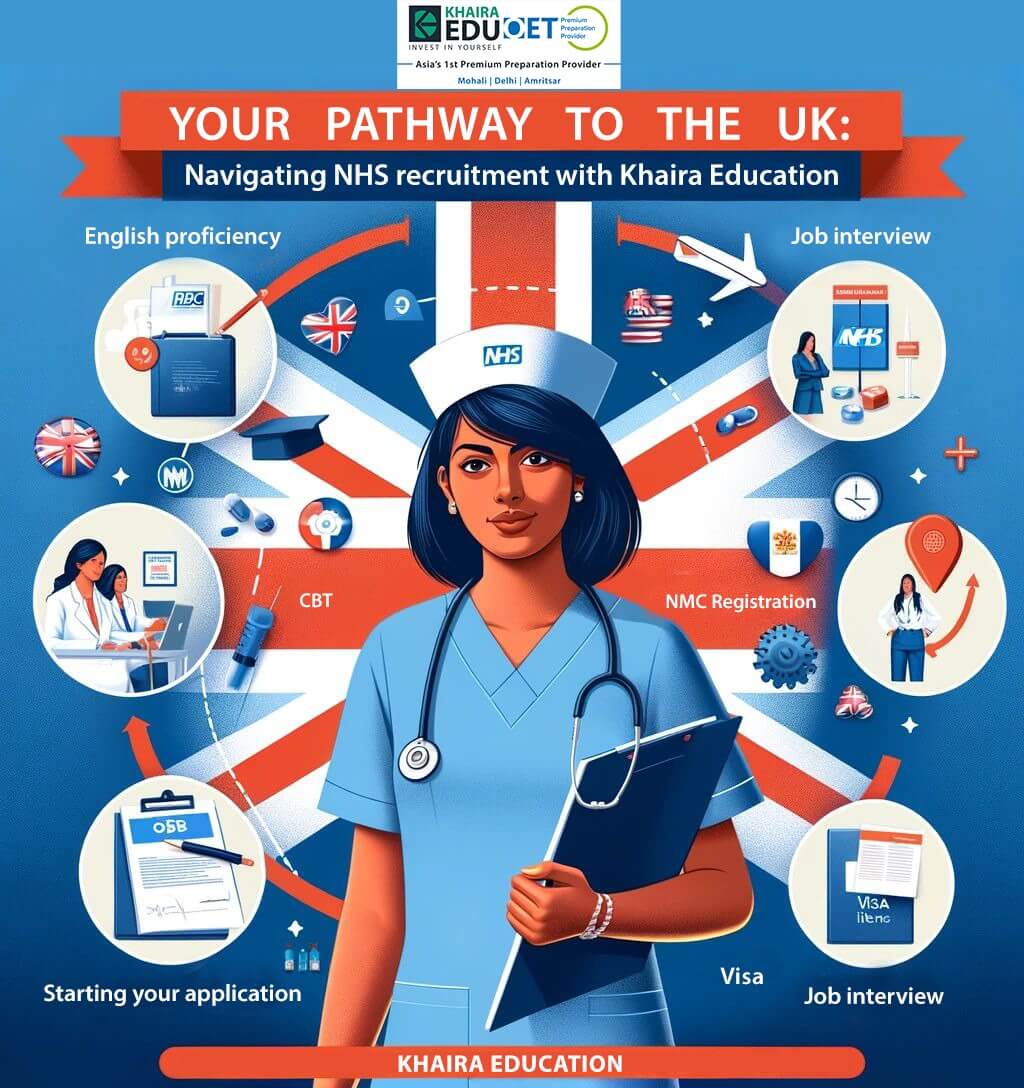
The recruitment process for Indian nurses looking to work in the NHS in the UK involves several key steps:

English Language Proficiency: Candidates must demonstrate their proficiency in English, which is essential for communication in healthcare settings in the UK. This can be achieved by passing either the IELTS (International English Language Testing System) or OET (Occupational English Test). The required scores are:
IELTS: A minimum score of 7 in reading, speaking, and listening, and 6.5 in writing.
OET: A minimum grade of B in reading, speaking, and listening, and C+ in writing.

If you want to know more about how scores can be clubbed from two test sittings, please refer to this reel by Khaira Education:
https://www.instagram.com/reel/CliwibsuKi_/?igsh=Nzg0ejJjOGRienAz

NMC Eligibility & Qualification Application: Nurses need to create an online account and complete an eligibility and qualification application with the Nursing and Midwifery Council (NMC). The NMC confirms eligibility for registration usually within 14 days. Experts at Khaira Education can help you with this process.

Computer-Based Test (CBT): Applicants must take a CBT, which assesses their knowledge and skills to practice nursing in the UK. The results of this test are typically available within 48 hours.Unique to Khaira Education, we provide free Computer-Based Testing (CBT) preparation materials, an essential component for nurses’ recruitment to the UK. This added value by Khaira Education ensures comprehensive readiness for both OET and other necessary examinations.

Job Interview & Job Offer: Nurses attend a direct or online interview arranged by partner recruitment agencies. Upon successful completion of the interview, they secure a job offer and complete pre-employment checks.Khaira Education will provide exclusive preparation materials to assist you with your preparation.

Certificate of Sponsorship from Employer: After clearing the CBT exam, the employer assigns a Certificate of Sponsorship (CoS). The sponsorship reference number on the CoS is used for the Tier 2 visa application.

Tier 2 Health & Care Worker Visa Application: The applicant submits their Tier 2 visa application, including a biometric application. The visa is generally approved within 3 weeks.

Travel to the UK: Arrangements for travel, including flights, airport pickup, and temporary accommodation, are typically organized by the partner recruitment agency or the NHS trust.

Objective Structured Clinical Exam (OSCE): This exam assesses the clinical knowledge of the applicant. Results are emailed within five working days from the test date. This needs to be completed within 90 days from date of starting your job in the UK.

Complete NMC Registration: After passing the OSCE, nurses submit health, character, and language evidence to the NMC. Successful candidates receive a Registration Number from the NMC (PIN).

This process involves careful planning and preparation, especially in terms of meeting the language requirements and passing the necessary examinations. Recruitment agencies play a crucial role in guiding candidates through this process and ensuring a smooth transition to working in the UK NHS.Khaira Education can make the transitions between different steps as smooth as possible.

Why OET Matters:

OET is recognized by the UK’s Nursing and Midwifery Council, making it a mandatory step for nurses aiming to work in the NHS. It differs from other English proficiency tests by focusing on language skills needed in healthcare settings.

Choosing the Best OET Coaching:

Effective OET preparation is crucial. Prospective nurses should seek coaching that offers experienced instructors, tailored study plans, and comprehensive support – all hallmarks of Khaira Education’s program.

Khaira Education’s Excellence:

As Asia’s first Premium Preparation Provider for OET, Khaira Education stands out with its course designed by Gurleen Khaira, a distinguished author of 8 OET-preparation books and certified Master Trainer. They offer TESOL  and CELTA certified trainers, an online learning management system, and extensive support, contributing to their high student success rate.

Conclusion:

For nurses targeting a career in the UK’s NHS, excelling in OET is a pivotal step. Khaira Education emerges as a trusted partner in this journey, offering expert coaching, extensive resources, and unique benefits like free CBT and OSCE preparation.